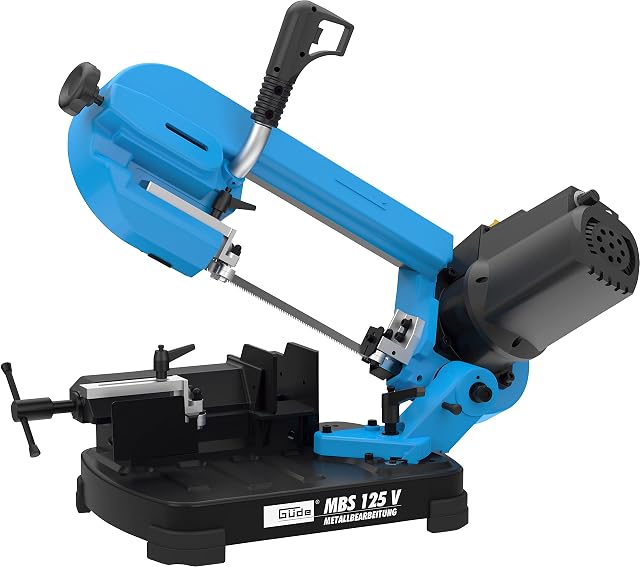
Break in a new blade
A new blade’s teeth are sharp enough to bite too deeply and chip. Run the first two or three cuts at reduced feed pressure so the tips hone slightly. Blades broken in this way last markedly longer, and it costs two minutes.
Pitch by the thinnest wall
At least three teeth must be in the cut at all times. On 2 mm (0.08 in) wall tube that means a fine pitch — 10/14 or 14/18; on solid bar, 6–10 clears chips better. A coarse blade on thin tube catches on the far edge and strips teeth in one cut.
Set the guides
Guides hold the blade square just before and after the cut. Bearings should just touch the blade without preloading it, and the back roller should be a hair behind the blade so it only contacts under feed pressure. Most saws that wander have loose or worn guides.
Feed lightly
A band saw cuts at the rate its teeth clear chips. Pushing harder does not speed it up; it deflects the blade and strips teeth. If a cut is slow, the pitch or the speed is wrong, not your patience.
The questions welders ask
Why does my saw cut a curve rather than a straight line?
Usually a dull blade or one worn unevenly on one side, sometimes worn guides, occasionally too much feed pressure. A blade with one side duller than the other steers itself. Once a blade has been forced through a hard inclusion, it rarely cuts straight again.
What band speed for steel?
Roughly 40 to 60 m (131 to 197 ft)/min for mild steel and slower for stainless; aluminum and brass want far faster. This is why a variable-speed machine matters if you cut both — a fixed-speed saw set for steel will clog its gullets in aluminum and rub rather than cut.
Last reviewed 2026-08-14