Where we come out Two proper speed ranges and the only depth readout on this shelf — on a machine that never says which spindle taper you are committing to.
Two things on this machine are better thought out than its price suggests. The first is the gearbox: two speed ranges, 50 to 1,125 rpm and 100 to 2,250, rather than one wide span. That matters because a variable-speed motor loses torque as it slows, and a range change lets the motor stay near its efficient speed while the spindle turns slowly — which is what a 20 mm (0.79 in) drill in steel actually needs.
The second is the LCD. It shows spindle speed, which is a convenience, and drilling and milling depth, which is not: a readout on the quill means a slot is cut to a dimension rather than to a scratch on a dial, and the units switch between inches and millimeters. No other machine on this shelf has one, and on a benchtop mill it is the difference between making a part and approaching one.
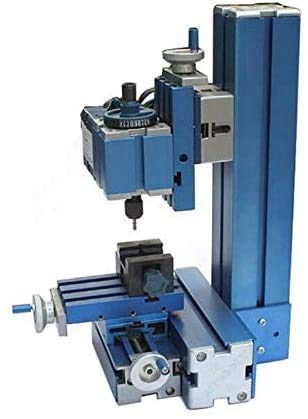
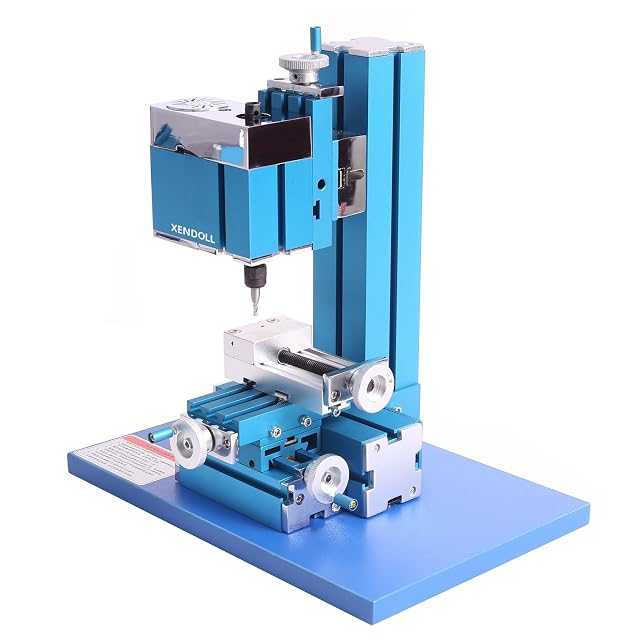
The motor is a 600 W pure-copper brushless unit with overload and overheating protection, belt driven, and the head tilts 45 degrees to the left for angled work. What the listing never says is the spindle taper — and this hub’s introduction singles out the tooling standard as the cost you buy into once and pay for indefinitely. R8, MT2, MT3 and MT3-ER32 all appear on machines this size, and nothing bought for one fits another. The table size, the axis travels and the spindle-to-table distance are also absent, which between them decide what will fit under the cutter.
Availability
Read on the day this page was built: $1877 at the American Amazon shop.
Read from Keepa on the day this page was last revised; stock and price both move without notice.
Prices quoted in this text were read on 2026-10-07. The live price is at the top of the page.
What it handles, and what it will not
Strengths
Publishes two separate speed ranges — 50 to 1,125 and 100 to 2,250 rpm — rather than one span
An LCD showing spindle speed AND drilling and milling depth, switchable between inches and millimeters
A 600 W pure-copper brushless motor with overload and overheating protection stated
The head tilts 45 degrees to the left by loosening the top screws
Belt driven, which protects the motor when a cutter binds
The lowest-priced of the three real bench mills in the American half of this hub
Compromises
No spindle taper published, which this hub’s introduction calls the cost you pay indefinitely
No table size, no axis travel and no spindle-to-table distance published
No runout figure
600 W is half the power of the two mills above it on this shelf
The head tilts one way only — 45 degrees left, where the dearer machines here tilt 90 degrees either side
Specifications
Amazon reference
B0FL1G6CYV
EAN
0198462358873
The questions welders ask
Why are two speed ranges better than one?
Because torque falls as a variable-speed motor slows. A single 50 to 2,250 rpm range sounds wider than two ranges of 50 to 1,125 and 100 to 2,250, and it is — but at 100 rpm in a single wide range the motor is turning at a twentieth of its rated speed and producing very little torque. A two-range gearbox lets the motor stay near its efficient speed while the spindle turns slowly, which is exactly what a large drill in steel needs. This hub’s drill press shelf makes the same argument.
What does the LCD actually add?
Depth, which is the hard part. A speed readout is a convenience; a depth readout on the quill means a milled slot or a drilled hole can be taken to a dimension rather than to a line on a dial, and the units switch between inches and millimeters. On a benchtop mill that is the difference between a part and an approximation, and no other machine on this shelf has one.
What is the missing figure that matters most?
The spindle taper. This hub’s introduction is explicit that the tooling standard is the hidden cost — "which you buy into once and pay for indefinitely" — and this listing does not name one. R8, MT2, MT3 and MT3 with an ER32 nut are all common on machines of this size, and collets, holders and arbors for one are useless on another. The two INTBUYING mills above it on this shelf name theirs, and disagree with each other about one of them.
The two nearest machines on price
Same shelf, nearest price — what else that money puts on the bench.
A bench where the depth of cut has to be read rather than counted on a dial
Sources
Specifications: the manufacturer sheet for welding and metalworking machines and the matching Amazon product page. Prices and availability: Keepa. Every figure on this page names its source.
12 V DC · lathe and mill in one · tool-height shims · soft metals only
A 12-volt combination mini lathe and mill that supplies shims to set the tool height — the one adjustment that decides whether a small lathe cuts or rubs.
Best for: Teaching turning and milling on one machine, in wood, plastic and pure copper or aluminum
7 in swing · 14 in centers · 2,500 rpm variable · reversible · DRO
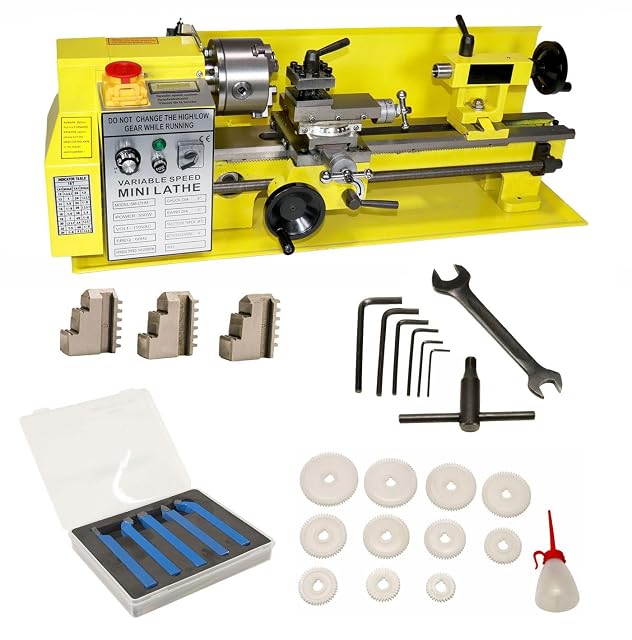
The only real metal lathe in the American half of this hub — 7 by 14 inches, variable to 2,500 rpm, reversible for left-hand threads, with a digital readout and a cutter kit.
Best for: Turning steel parts on a bench, where the tooling has to come with the machine