Skip to content

ESAB 700600860

Nine stored settings, half-shade steps and the largest published window on this shelf — and a switching time that is slower than a forty-dollar helmet’s.

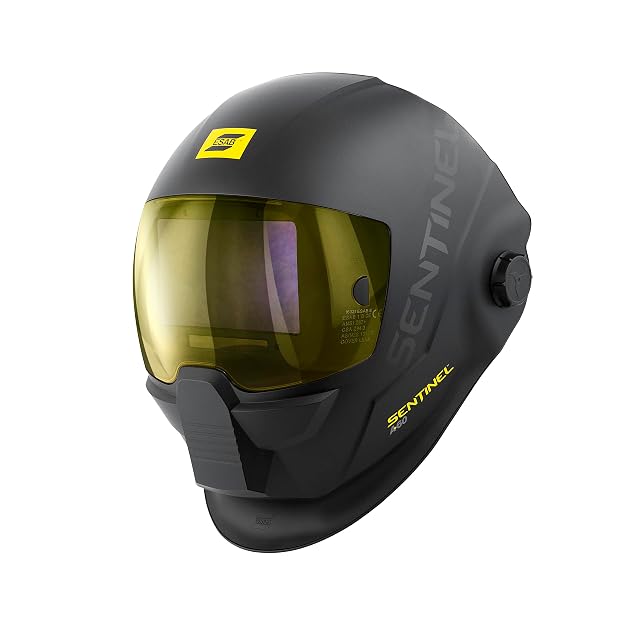
ESAB Sentinel A60 low-profile welding helmet with a large viewing window

ESAB 700600860

Nine stored settings, half-shade steps and the largest published window on this shelf — and a switching time that is slower than a forty-dollar helmet’s.

Amazon reference
B0BLQ92744
EAN
7330725068591
  • The largest published window here — 4.65 by 2.80 in, about 13 square inches
  • Shade adjustable in 0.5 steps across DIN 3/5-13, with a shade lock
  • A published switching time of 0.08 millisecond is 1/12,500 second — slower, as published, than the 1/23,000 and 1/30,000 figures elsewhere on this shelf

Best for: A shop that switches process and material all day and wants the settings recalled, not redialled

≈ $350
Check price on Amazon
Specifications

Amazon reference
B0BLQ92744
EAN
7330725068591

This is the best-documented helmet on the shelf. ESAB publishes the viewing area as two dimensions — 4.65 by 2.80 in, about thirteen square inches, the largest here — a shade range of DIN 3/5-13 adjustable in half steps, four arc sensors, nine on-board memory settings, a shade lock, a replaceable CR2450 and three indicator lights for battery, grind mode and shade lock.

Half-shade steps and stored settings are what separate a helmet used by one person on one job from one used across processes. A half step is the difference between a shade that is slightly too dark on thin stainless and one that is right; nine memories mean that difference is set once. Nothing else on this shelf has memory, and the only other helmet in this hub with stored settings is the European Titan.

And then there is the switching time, which is published and does not flatter the price. Nought point nought eight of a millisecond is one twelve-thousand-five-hundredth of a second. The Miller Classic here publishes one twenty-three-thousandth and both YESWELDERs one thirty-thousandth, for a fraction of the money. The explanation is almost certainly that these are not the same measurement — cartridge switching slows as the lens cools, and a cautious figure and an optimistic one look identical on a bullet point. No listing on this shelf publishes the temperature it tested at, which is why the comparison is worth stating rather than resolving.

Availability

Read on the day this page was built: $350 at the American Amazon shop.

Read from Keepa on the day this page was last revised; stock and price both move without notice.

Prices quoted in this text were read on 2026-10-07. The live price is at the top of the page.

The questions welders ask

Why is the switching time slower than a cheap helmet’s?

Because the figures are not measured the same way, and no listing on this shelf says how. ESAB publishes 0.08 millisecond, which is 1/12,500 second. Miller publishes 1/23,000 and both YESWELDERs publish 1/30,000 — on paper, two to three times faster. In practice a cartridge’s switching time depends on temperature, and the honest reading is that ESAB has published a figure under conditions it is confident of while the others have published a nominal best case. The arithmetic is given here because it is checkable; what is not published is the test behind any of the four.

What do nine memories actually save?

The time between processes. Shade, sensitivity and delay for low-amp TIG on stainless are not the settings for 150-amp MIG on mild steel, and a helmet without memory means redialling three controls each time. Nine stored sets covers most of a shop’s work, and this is the only helmet on this shelf with on-board memory — the European STAHLWERK Titan here is the only other helmet in the hub to offer stored settings at all.

All helmets & ppe