Skip to content

Miller 287803

A small window and a published switching time, from the only listing on this shelf that states the amperage it works down to.

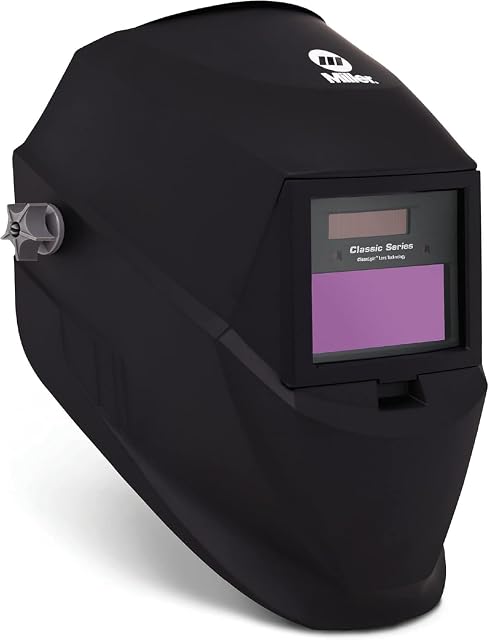
Miller Classic Series welding helmet with a digital control panel inside

Miller 287803

A small window and a published switching time, from the only listing on this shelf that states the amperage it works down to.

Amazon reference
B096D7RCSH
EAN
0715959681254
  • States the current it works down to — five amps or below, which no other listing on this shelf does
  • Publishes a switching time, 1/23,000 second, and a sensor count
  • Six square inches is the smallest window on this shelf

Best for: Low-amperage TIG, where the lens has to darken on an arc a big sensor set would miss

≈ $135
Check price on Amazon
Specifications

Amazon reference
B096D7RCSH
EAN
0715959681254

Six square inches is a small window, and Miller publishes it as an area rather than as a single dimension — which on this shelf already puts the listing ahead of the Hobart, whose “9.3 in” cannot be squared. What you get for the restriction is a helmet aimed at precision rather than coverage.

The figure that justifies it is the current. Miller states the helmet is suited to “welding at five amps or below”, which is the one statement on this shelf about the thing that actually fails on cheap cartridges: a dim low-amp TIG arc that the sensors do not see. Every other listing here either claims low-amp capability without a number or says nothing. Two sensors with a stated low-amp claim is a different proposition from four sensors with none.

The rest is well-documented and conventional: a published switching time of 1/23,000 second, separate bands for welding, cutting and grinding, digital controls for shade, delay and sensitivity, ratchet headgear, a 3.0 light state so the hood can stay down between welds, ANSI Z87.1+, CSA and CE markings and a three-year warranty. The gap is the optical class — the four digits this hub asks for — on a helmet whose selling point is its optics.

Availability

Read on the day this page was built: $125 at the American Amazon shop.

Read from Keepa on the day this page was last revised; stock and price both move without notice.

Prices quoted in this text were read on 2026-10-07. The live price is at the top of the page.

The questions welders ask

What does "five amps or below" tell me?

It is the closest thing on this shelf to a trigger current, and it is the figure that decides low-amp TIG. Below about 20 amps the arc is dim enough that a cartridge with insensitive sensors can fail to darken, which means an unprotected flash. Miller states the helmet is "Perfect for welding at five amps or below" with two sensors, where several helmets here claim low-amp capability with four sensors and no figure. It is a claim rather than a measurement, and it is the only one of its kind here.

Is the switching time comparable with the others?

Only loosely, and this is worth knowing before paying for a faster number. Miller states 1/23,000 second, both YESWELDERs state 1/30,000, and the ESAB states 0.08 millisecond — which is 1/12,500 second, the slowest of the four. No listing on this shelf says at what temperature the figure was taken, and switching time lengthens as a cartridge cools. Comparing them as published is comparing four measurements made under unstated conditions.

All helmets & ppe