Skip to content

YESWELDER LYG-M800H

Two and a half times the glass of its cheaper stablemate, with four arc sensors instead of two — and the same published optical class.

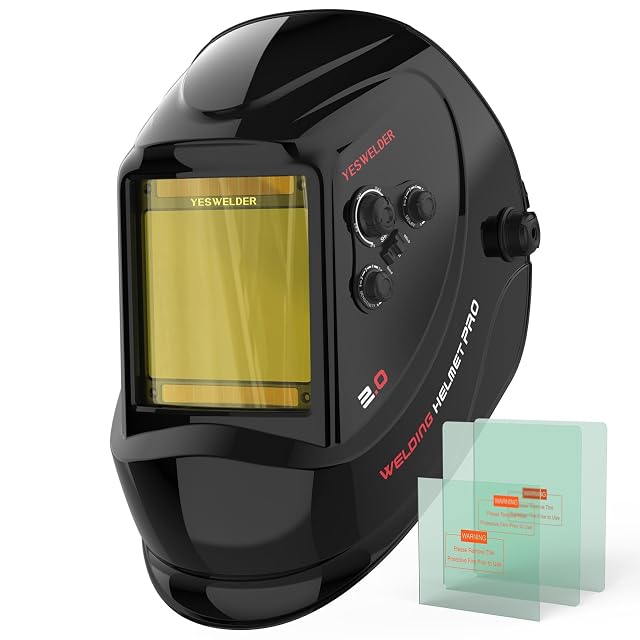
YESWELDER large-view welding helmet with a wide true-color window

YESWELDER LYG-M800H

Two and a half times the glass of its cheaper stablemate, with four arc sensors instead of two — and the same published optical class.

Amazon reference
B07M5WKCYX
EAN
0768563619526
  • 3.93 by 3.66 in — about 14 square inches, the second largest window on this shelf
  • Publishes 1/1/1/1 optical class, a 1/30,000 second switching time and four arc sensors
  • No trigger current stated, so low-amp TIG detection is still unproven on the page

Best for: Following a long seam or welding in an awkward position, where a small window means moving your head

≈ $60
Check price on Amazon
Specifications

Amazon reference
B07M5WKCYX
EAN
0768563619526

This is the same cartridge grade as the cheapest helmet on this shelf — 1/1/1/1, 1/30,000 second — in a helmet built around a much larger window and twice the sensors. At 3.93 by 3.66 in it gives about fourteen square inches of glass, against six on its stablemate and six stated flat on the Miller Classic here.

Four arc sensors is the other half of the upgrade, and it is the specification that matters when your own hand, the work or a corner blocks the line between the arc and the cartridge. Two sensors in open air are fine; four are what the helmets built for pipe and confined spaces carry, and on this shelf the only other helmets with four are the Hobart and the two at the top of the price range.

The weight is published, which is rare: about 600 grams. That puts it above the 12 to 13 ounces claimed by the flip-up helmet here and in the ordinary range for a large-window helmet, where the glass sits forward of the pivot. What is still missing, as on every helmet on this shelf, is a trigger current — the figure that says whether the lens will darken on a 10-amp TIG arc rather than a 100-amp MIG one.

Availability

Read on the day this page was built: $60 at the American Amazon shop.

Read from Keepa on the day this page was last revised; stock and price both move without notice.

Prices quoted in this text were read on 2026-10-07. The live price is at the top of the page.

The questions welders ask

How much difference does the bigger window make?

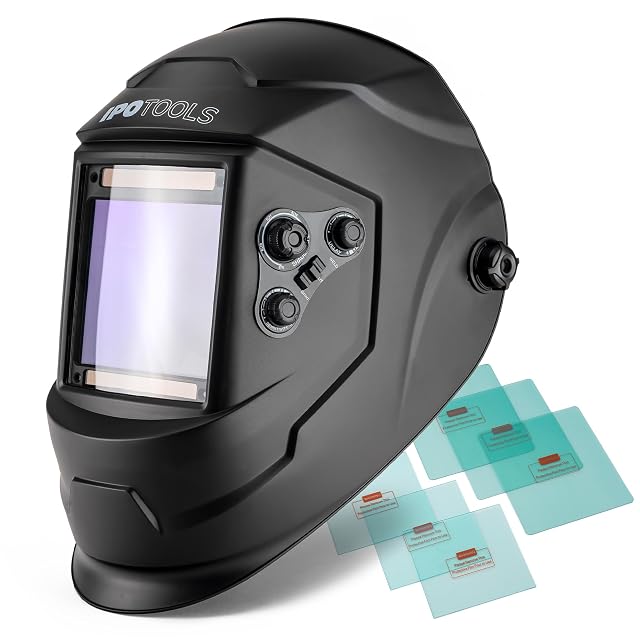
It is the difference between seeing the joint and seeing the puddle. At 3.93 by 3.66 in this is about 14 square inches against about 6 on the cheaper YESWELDER and 6 stated flat by the Miller Classic on this shelf. On a long seam, a small window means lifting your head to find the next inch, which is where a bead wanders. The European IPOTOOLS helmet on this shelf publishes 100 by 93 mm (3.66 in), which is close to this one.

Why two shade ranges instead of one?

DIN 3/5-9 covers cutting and low-amp work, 9-13 covers welding proper. Splitting them lets the dial be finer within each band, and it means a deliberate action to move between them rather than a long sweep through shades you never use. The cost is that the band has to be chosen before the dial means anything.

All helmets & ppe