Where we come out The slowest bottom gear of the stepped bench presses here, on the thinnest specification page of any machine on this shelf.
Of the two stepped bench presses in the American half of this shelf, this is the one geared closest to what steel wants. Five speeds from 620 to 3,100 rpm, driven by a quarter-horsepower induction motor — and 620 rpm at the bottom is about twenty per cent fast for a 13 mm (0.51 in) bit in mild steel, where the 750 rpm press alongside it is about fifty per cent fast. This hub’s buying tip is that the lowest speed is the number to read, and this is the lower.
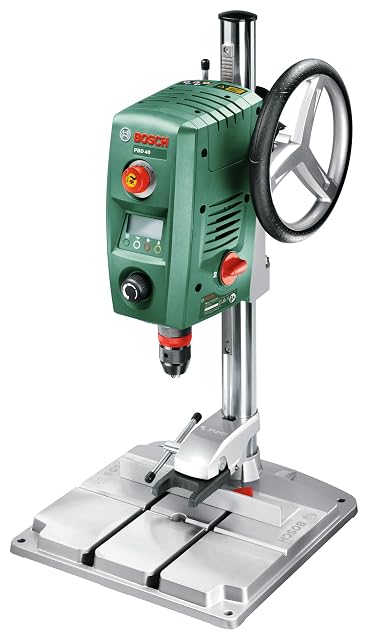
The rest of the machine is conventional and sensibly equipped: a depth stop for repeat holes, a table that swivels through 360 degrees and tilts to 45, an LED work light, and a laser alignment system that shows where the spindle axis meets the table. On wood the laser is genuinely useful; in steel the hole starts from a center punch and the drill point follows the punch, so the laser earns its place at setup rather than at the cut.
What is missing is the specification. This listing has no bullet points at all — a single paragraph of description — so the quill travel, the chuck capacity, the table size and the weight are nowhere on the page. Quill travel in particular is the figure that decides how thick a part can be drilled in one pass, and every other bench press in this hub publishes it.
Availability
Read on the day this page was built: $199 at the American Amazon shop.
Read from Keepa on the day this page was last revised; stock and price both move without notice.
Prices quoted in this text were read on 2026-10-07. The live price is at the top of the page.
What it handles, and what it will not
Strengths
A 620 rpm bottom gear, which is closer to what steel wants than the 750 rpm press on this shelf
Publishes the full speed range, 620 to 3,100 rpm in five steps
A 1/4 HP induction motor rather than a brushed one
An LED work light and a laser alignment system to place the hole
A table that swivels through 360 degrees and tilts 45 degrees
A depth stop, which is what makes repeat holes possible
Compromises
The listing is a description with no bullet specifications at all
No quill travel published, which is the figure that decides what thickness it will drill
No chuck capacity published
No table size and no overall weight published
A laser is an alignment aid, not a substitute for a center punch in steel
Specifications
Amazon reference
B0C5G9D49P
EAN
0715450476335
The questions welders ask
Why is 620 rpm better than 750?
Because it is closer to the speed steel actually wants. This hub’s buying tip puts a 13 mm (0.51 in) bit in mild steel at roughly 500 rpm, and the penalty for running fast is a blunt bit rather than a slow hole. At 620 rpm a 13 mm (0.51 in) drill is about twenty per cent fast; at 750 it is about fifty. Neither is ideal and the difference is real — and of the two stepped bench presses on this shelf, this is the slower.
Is the laser worth anything on metal?
A little, and less than on wood. A crossed-line laser shows where the spindle axis meets the table, which helps place a part roughly before clamping. In steel the hole is started from a center punch mark and the drill point finds it — if the punch mark and the laser disagree, the punch mark wins. What the laser genuinely saves is the first setup on a part you cannot see past.
What is not on this page?
Most of it. There are no bullet specifications at all — only a paragraph of description — so the quill travel, the chuck capacity, the table size and the machine weight are all absent. Quill travel is the figure that decides what thickness can be drilled in one pass, and it is published by every other bench press in this hub, European and American.
The two nearest machines on price
Same shelf, nearest price — what else that money puts on the bench.
A bench where the hole has to land where the line says, in steel up to about 10 mm (0.39 in)
Sources
Specifications: the manufacturer sheet for welding and metalworking machines and the matching Amazon product page. Prices and availability: Keepa. Every figure on this page names its source.
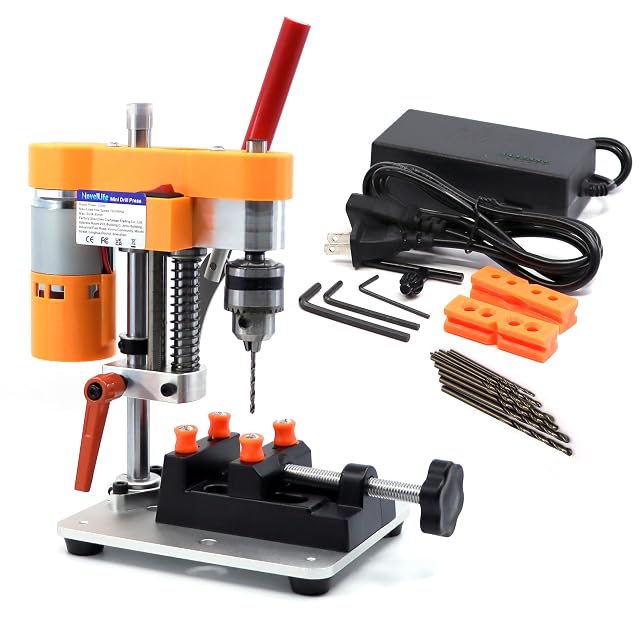
795 DC motor · 7,000 rpm max · 40 mm (1.57 in) stroke · B10 chuck 0.6–6 mm (0.02 to 0.24 in)
A mini drill press for 0.6 to 6 mm (0.02 to 0.24 in) bits, with a 24 V variable supply and a 40 mm (1.57 in) stroke — the only machine in this hub built for work smaller than a drill chuck normally reaches.
Best for: Circuit boards, model work and small holes in soft material, where a full-size press cannot grip the bit