Where we come out A well-documented magnetic drill at a quarter of the price of the alternative here, geared at one fixed 800 rpm for cutters up to 40 mm (1.57 in) — which is two to three times too fast at the top of its own range.
A magnetic drill exists to take the machine to the work: a 12,500 newton electromagnet clamps it to a beam or a plate and the cutter goes through from whatever angle the steel happens to be at. This one publishes the figures that matter for that — 2,810 lbf and 12,500 N of hold, a minimum plate thickness of 10 mm (0.39 in), a 40 mm (1.57 in) maximum boring diameter and 50 mm (1.97 in) of depth, a 1,400 W motor, eleven cutters in the box and a millimeter scale on the frame to set the start point.
Then it publishes one speed: 800 rpm. This hub’s buying tip is that a 25 mm (0.98 in) cutter wants far less than 500 rpm, because cutting speed is set by the rim of the tool and a bigger cutter needs fewer turns. A 40 mm (1.57 in) annular cutter wants something in the region of 200 to 300 rpm. At 800 it rubs, blues and loses its edge — and annular cutters are not cheap. At 12 to 16 mm (0.47 to 0.63 in) the same gear is about right, so the machine is correctly geared for the bottom of its own stated range and badly geared for the top of it.
Two other limits are stated plainly, which is to the listing’s credit: not for stainless steel, not for cast iron. Both come back to the same single speed. One oddity on an American listing: the manufacturer reference on the page is written in French.
Availability
Read on the day this page was built: $176 at the American Amazon shop.
Read from Keepa on the day this page was last revised; stock and price both move without notice.
Prices quoted in this text were read on 2026-10-07. The live price is at the top of the page.
What it handles, and what it will not
Strengths
Publishes the magnet holding force in both units — 2,810 lbf and 12,500 N
Publishes the maximum boring diameter and depth: 40 mm (1.57 in) and 50 mm (1.97 in)
A 1,400 W motor, and eleven coring bits supplied
A millimeter scale on the frame to set the distance from bit to work
States the minimum plate thickness the magnet needs: 10 mm (0.39 in)
States what it is not for: stainless steel and cast iron
A fraction of the price of the other magnetic drill on this shelf
Compromises
One fixed speed, 800 rpm, with a 40 mm (1.57 in) cutter capacity — this hub’s buying tip says a 25 mm (0.98 in) cutter wants far less than 500 rpm
Not suitable for stainless steel or cast iron, per the listing
Needs a steel plate of at least 10 mm (0.39 in) for the magnet to hold
Its manufacturer reference is written in French on an American listing
No runout, no spindle taper and no cutter shank standard published
Specifications
Amazon reference
B0DWFM4PGX
EAN
0197988122548
The questions welders ask
Is 800 rpm usable with a 40 mm (1.57 in) cutter?
Not really, and this is the clearest case on the shelf for the hub’s own buying tip. Cutting speed depends on the rim speed of the tool, so a bigger cutter needs fewer revolutions: an annular cutter of 40 mm (1.57 in) in mild steel wants roughly 200 to 300 rpm, and 800 rpm puts its rim at nearly three times the right speed. The practical result is a cutter that blues, loses its edge in a few holes and costs more than the difference to the two-speed machine. At 12 to 16 mm (0.47 to 0.63 in), 800 rpm is about right — so the machine is correctly geared for the small end of its own stated range and badly geared for the large end.
Why can it not do stainless or cast iron?
The listing says so without explaining, and both have the same cause: speed and heat. Stainless work-hardens if the cutter rubs instead of cutting, which is exactly what happens at too high an rpm, and cast iron is abrasive and needs a slower, heavier feed. A single 800 rpm gear leaves no way to slow down for either. Cast iron is also non-magnetic enough in some grades to weaken the hold, which matters more than it sounds on a machine held on by a magnet.
What does 2,810 lbf of magnet mean in practice?
It is the holding force on clean, flat steel of at least 10 mm (0.39 in), which the listing states. Thinner plate carries less of the magnetic circuit and the hold falls away sharply; paint, rust or scale under the base does the same. Publishing the figure in both pounds-force and newtons, with the minimum plate thickness alongside it, is the most useful thing on this page.
The two nearest machines on price
Same shelf, nearest price — what else that money puts on the bench.
Holes in structural steel plate of 10 mm (0.39 in) or more, where the machine has to go to the work
Sources
Specifications: the manufacturer sheet for welding and metalworking machines and the matching Amazon product page. Prices and availability: Keepa. Every figure on this page names its source.
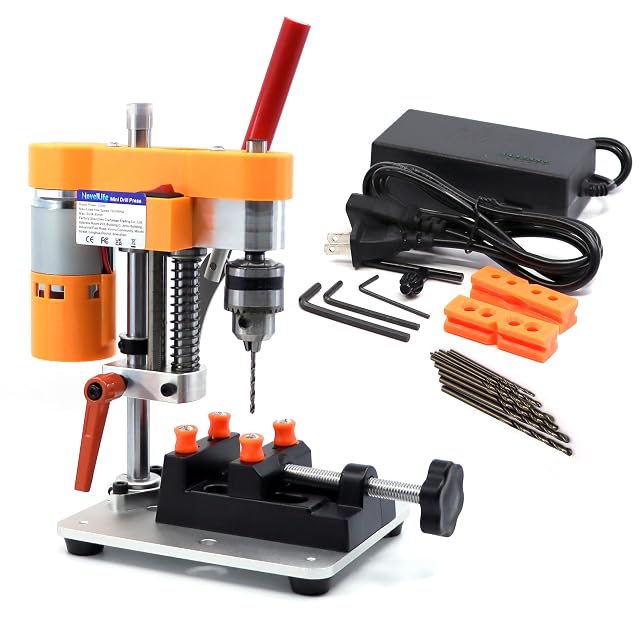
795 DC motor · 7,000 rpm max · 40 mm (1.57 in) stroke · B10 chuck 0.6–6 mm (0.02 to 0.24 in)
A mini drill press for 0.6 to 6 mm (0.02 to 0.24 in) bits, with a 24 V variable supply and a 40 mm (1.57 in) stroke — the only machine in this hub built for work smaller than a drill chuck normally reaches.
Best for: Circuit boards, model work and small holes in soft material, where a full-size press cannot grip the bit