Where we come out A well-specified small press let down by a 750 rpm bottom gear — right for bits up to 8 mm (0.31 in) in steel, wrong for the 13 mm (0.51 in) its chuck will hold.
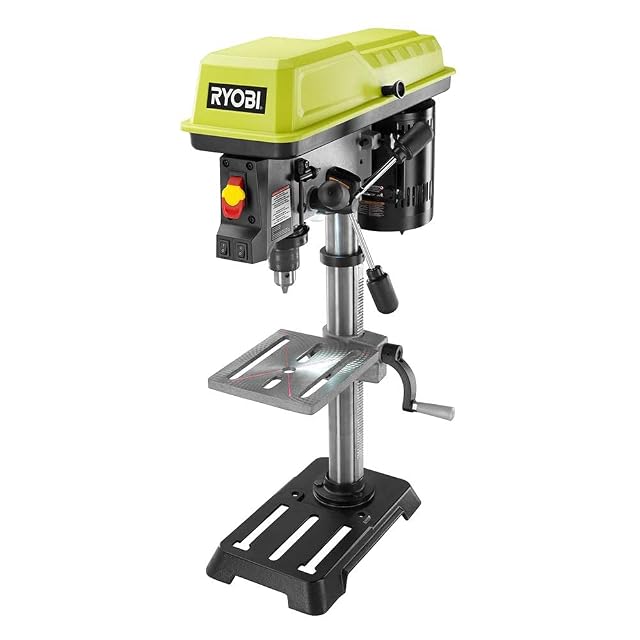
The specification is published in full, which on this shelf is worth saying first: a 2.3 A induction motor on ball bearings, five speeds at 750, 1,100, 1,500, 2,100 and 3,200 rpm, an 8 in swing, 2 in of spindle travel, a 1/2 in keyed chuck, a 6.5 in square table that bevels 45 degrees each way, and overall dimensions of 23 in tall on a 7 by 11 in base.
Two of those figures are the machine’s limits and they point the same way. The bottom speed is 750 rpm, and this hub’s buying tip is explicit that a drill whose slowest gear is around 800 rpm will overheat and blunt every large bit you own — a 13 mm (0.51 in) drill in mild steel wants roughly 500. The chuck will close on 13 mm (0.51 in); the machine will not drill it well. Up to about 8 mm (0.31 in) the speed is appropriate and the press is a good one.
The travel is the other. Two inches is the shortest on this shelf, so a part thicker than 51 mm (2.01 in) has to be drilled in two bites with the table moved between them. What the machine does have is the thing small presses usually lack: cast iron mass and an induction motor, which together are why it drills more accurately than its price suggests. No runout figure is published, here or anywhere on this shelf.
Availability
Read on the day this page was built: $124 at the American Amazon shop.
Read from Keepa on the day this page was last revised; stock and price both move without notice.
Prices quoted in this text were read on 2026-10-07. The live price is at the top of the page.
What it handles, and what it will not
Strengths
An induction motor on ball bearings rather than a brushed universal motor, which is quieter and lasts
Publishes all five speeds — 750, 1,100, 1,500, 2,100 and 3,200 rpm
Cast iron construction, which is mass where a small press needs it
A 1/2 in keyed chuck with onboard key storage
A table that bevels 45 degrees either way and adjusts for height
Publishes its own height, 23 in, and base size, 7 by 11 in
Compromises
The slowest speed is 750 rpm, and this hub’s buying tip says a bottom gear of 800 will blunt every large bit you own
Two inches of quill travel, the shortest on this shelf
A 2.3 A motor is about 270 W at 120 V — the smallest on this shelf by a wide margin
A 6.5 by 6.5 in table is small for anything but a clamped-down part
No runout figure published
Specifications
Amazon reference
B08ZVWRZR9
EAN
0044459420606
The questions welders ask
Is 750 rpm slow enough?
Barely, and only for small holes. This hub’s buying tip puts a 13 mm (0.51 in) bit in mild steel at roughly 500 rpm and warns that a drill whose bottom gear is 800 rpm will overheat and blunt large bits. At 750 rpm this machine is fine for bits up to about 8 mm (0.31 in) in steel and increasingly wrong above that — the chuck will take 13 mm (0.51 in), and the speed will cook it. In wood or aluminum the same speed is unremarkable.
What does two inches of quill travel limit?
How thick a part you can drill in one pass. Two inches is 51 mm (2.01 in), so anything deeper has to be drilled, the table lowered, and the hole picked up again — which rarely stays concentric. It is the shortest travel on this shelf; the published European presses here run from 50 to 90 mm (1.97 to 3.54 in), and the 12-inch WEN further down this page has more.
The two nearest machines on price
Same shelf, nearest price — what else that money puts on the bench.
Small holes in steel and general bench work, where the machine has to be short enough to live under a shelf
What buyers actually choose
Amazon reports what buyers took in the month before this page was last checked: at least 400.
The figure is a floor, rounded by Amazon, and read through Keepa — it says what buyers picked, not what a maker claims.
Sources
Specifications: the manufacturer sheet for welding and metalworking machines and the matching Amazon product page. Prices and availability: Keepa. Every figure on this page names its source.