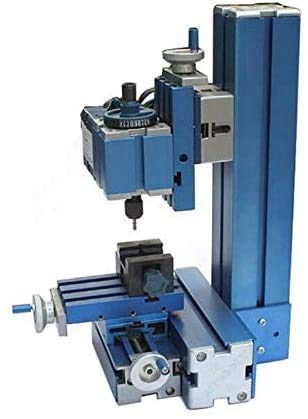
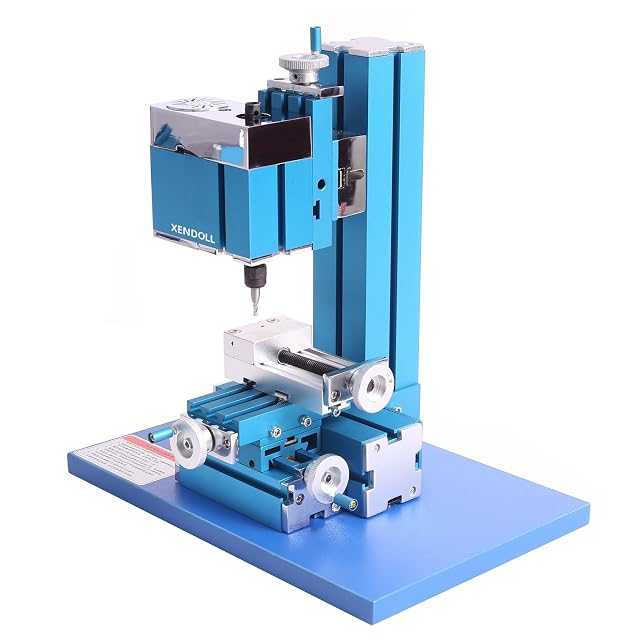
Where we come out Twelve published specifications including the only spindle runout figure in this hub — on a 24-watt machine that makes parts the size of a matchbox.
This hub’s introduction says bench lathes should be compared on swing, distance between centers and spindle bore, and its sister instruction for every machine on this shelf is runout. Of thirteen machines in this hub, this is the only one that publishes a runout figure: spindle jump under 0.1 mm (0.004 in).
It publishes eleven other things besides. Input 100-240 V AC and output 12 V DC at 2 A. A 24 W motor turning at 20,000 rpm with a ±15 per cent tolerance, geared to a 3,000 rpm spindle. X travel 45 mm (1.77 in), Y and Z 35 mm (1.38 in). A vice opening 50 by 60 mm (2.36 in). Collets from 1 to 6 mm (0.04 to 0.24 in) in eight sizes, cutters in four. A handle scale of 0.05 mm (0.002 in) per division — twice the resolution of the XENDOLL machines on this shelf. And its own weight, 3.5 kg (7.7 lb).
What all of that describes is a precision machine for very small parts, which is a coherent thing to be. The materials are named and the limit is in capitals: wood, plastic, plexiglass, aluminum, copper, and it “CAN’T processing alloy”. The one caution about the headline figure is that ”< 0.1 mm (0.004 in)” is a limit rather than a measurement — it says the spindle is no worse than that, not what it is. Its reference, FT-028371, shares the digits 028371 with an INTBUYING machine on this shelf whose listing publishes no figures at all.
Availability
Read on the day this page was built: $209 at the American Amazon shop.
Read from Keepa on the day this page was last revised; stock and price both move without notice.
Prices quoted in this text were read on 2026-10-07. The live price is at the top of the page.
What it handles, and what it will not
Strengths
Publishes a spindle runout figure — jump under 0.1 mm (0.004 in) — which no other machine in this hub states
Publishes a 0.05 mm (0.002 in) handle scale, twice the resolution of the XENDOLL machines here
Publishes both axis travels: 45 mm (1.77 in) on X, 35 mm (1.38 in) on Y and Z
Publishes the vice capacity, 50 by 60 mm (2.36 in), and the collet range, 1 to 6 mm (0.04 to 0.24 in)
Publishes its own weight, 3.5 kg (7.7 lb), and the full input and output voltages
Belt drive, all-metal body, and cutters supplied in 3, 4, 5 and 6 mm (0.24 in)
Compromises
Twenty-four watts: wood, plastic, plexiglass, aluminum and copper, with alloys excluded in capitals
A 45 mm (1.77 in) X travel is the size of a matchbox — this machine makes small parts
A runout figure quoted as "< 0.1 mm (0.004 in)" is a limit rather than a measurement
Its reference shares the stem 028371 with an INTBUYING machine on this shelf that publishes nothing
Specifications
Amazon reference
B0FCY73FLX
EAN
0198462867368
The questions welders ask
Why is a runout figure worth so much?
Because this hub’s introduction names it first. Spindle runout is how far the spindle axis wanders as it turns, and it sets the floor on everything a machine can do: a hole drilled on a spindle with 0.1 mm (0.004 in) of runout cannot be rounder than 0.1 mm (0.004 in), whatever the cutter. Every other machine on this shelf, European and American, leaves it unstated — which means it cannot be compared at all. "Under 0.1 mm (0.004 in)" is a modest figure for precision work and a published one, which is more than the two-thousand-dollar mills at the other end of this shelf manage.
What does a 0.05 mm (0.002 in) handle scale change?
What you can actually set. A handle marked in 0.05 mm divisions can be moved to half the increment of one marked in 0.1 — and on a machine whose whole purpose is small, accurate parts, the dial resolution is the practical limit on accuracy long before the spindle is. It is twice the resolution of either XENDOLL machine on this shelf.
How small is small?
A 45 mm (1.77 in) X travel and 35 mm (1.38 in) on the other two axes, with a vice that opens to 50 by 60 mm (2.36 in). That is a part the size of a matchbox, machined with 1 to 6 mm (0.04 to 0.24 in) cutters. The machine weighs 3.5 kg (7.7 lb) complete. Everything about it is consistent, published, and clearly bounded — which on this shelf is rarer than power.
The two nearest machines on price
Same shelf, nearest price — what else that money puts on the bench.
Precision model work, where the resolution of the handles and the runout of the spindle are the whole question
Sources
Specifications: the manufacturer sheet for welding and metalworking machines and the matching Amazon product page. Prices and availability: Keepa. Every figure on this page names its source.
12 V DC · lathe and mill in one · tool-height shims · soft metals only
A 12-volt combination mini lathe and mill that supplies shims to set the tool height — the one adjustment that decides whether a small lathe cuts or rubs.
Best for: Teaching turning and milling on one machine, in wood, plastic and pure copper or aluminum
7 in swing · 14 in centers · 2,500 rpm variable · reversible · DRO
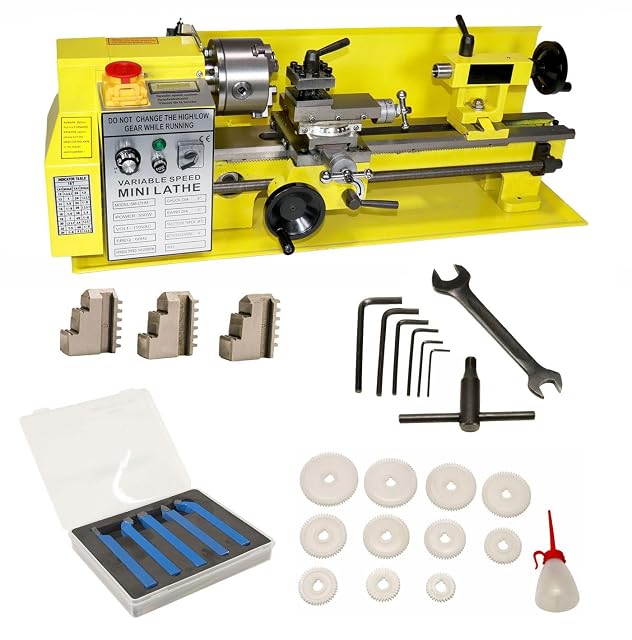
The only real metal lathe in the American half of this hub — 7 by 14 inches, variable to 2,500 rpm, reversible for left-hand threads, with a digital readout and a cutter kit.
Best for: Turning steel parts on a bench, where the tooling has to come with the machine