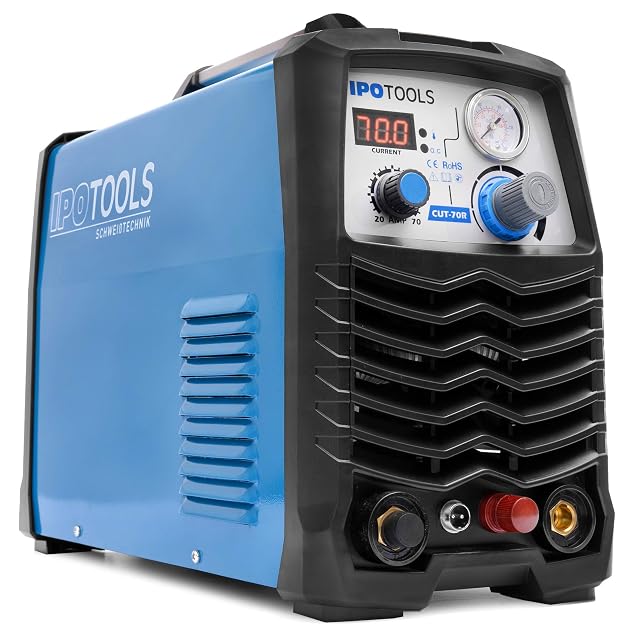
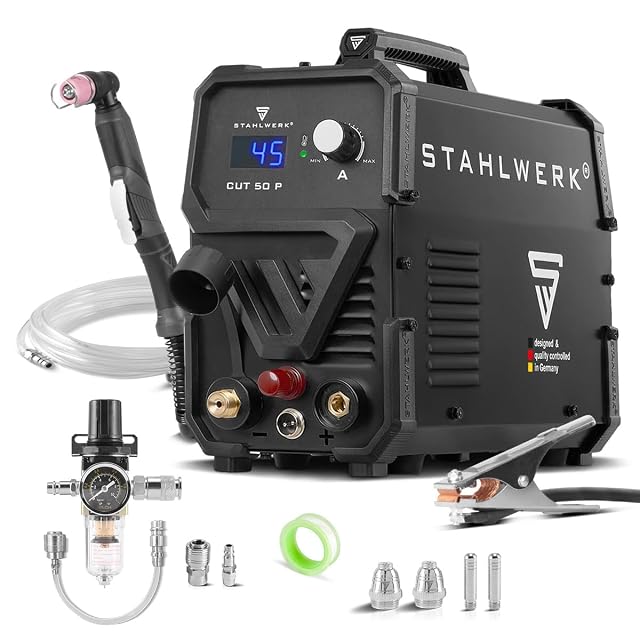
Where we come out The fullest specification on this page, and still no duty cycle at €750.
Seven hundred and fifty dollars, 80 A, and the most complete specification in this batch: three cut thicknesses by material, plus adjustable pre- and post-flow.
What the numbers mean here
Twenty-five millimeters in steel, fifteen in stainless, eight in aluminum. As always these are severance figures — the thickest the machine gets through — and clean, weldable cutting is roughly two thirds. That puts this machine at a comfortable 15 to 18 mm (0.59 to 0.71 in) in steel, which is genuinely beyond what the 45 and 60 A machines above it will do without a struggle.
The air timings, again
The cheap VEVOR machines publish flow timings and no thicknesses; the mid-range STAHLWERKs publish thicknesses and no timings. This one publishes both. Pre-flow settles the air and clears condensate before the arc; post-flow cools the nozzle and electrode afterwards, and it is the setting that most affects consumable life.
The compressor question
Eighty amps needs more air than 45, sustained. Read your compressor’s delivered output at working pressure rather than its tank size, and compare it against the machine’s stated air requirement before ordering. A cutter starved of air stalls mid-cut and blames itself.
The omission
No duty cycle, at €750. The €462 Stamos on this page publishes 85 A at 60%; this one publishes nothing, and at this price that is worth saying plainly rather than filling with a plausible number.
Sources
Current, cut thicknesses, gas management and technology come from the manufacturer’s published specification. No duty cycle is stated there, and none is invented here. Market availability was verified per market on the EAN.
Prices quoted in this text were read on 2026-08-13. The live price is at the top of the page.
What it handles, and what it will not
Strengths
Three published thicknesses and adjustable air timings — nothing else here gives both
Eighty amps means 15 to 18 mm (0.59 to 0.71 in) of clean cutting in steel, not just severance
Live on all six markets under one reference
Compromises
€750, and an 80 A machine will test a domestic supply
No duty cycle published, which at this price is a real omission
Air demand rises with current: a small compressor will not keep up
Specifications
Current
80 A
Cut thickness
25 mm (0.98 in) steel, 15 mm (0.59 in) stainless, 8 mm (0.31 in) aluminum
Gas management
Adjustable pre-flow and post-flow
Technology
IGBT inverter
Part number
6934
Amazon reference
B0GD196V7D
EAN
4262452499344
The questions welders ask
Does 80 A need a bigger compressor?
Yes. Higher current needs a larger nozzle orifice and more air through it, so both the flow and the sustained delivery matter — a compressor that keeps a 45 A machine happy will pant behind an 80 A one. Check the machine’s stated air requirement against your compressor’s delivered liters per minute at working pressure, not against its tank size.
Why does post-flow deserve a control of its own?
Because it decides how the consumables cool. When the arc stops, the nozzle and electrode are at their hottest; air running for another second or two takes that heat out. Cut it short and they oxidize; leave it long and you waste air and time. On a machine that will do a lot of cutting, being able to tune that is money saved in tips.
Our score
8.1/ 10
The fullest specification on this page, and still no duty cycle at €750.
Price and availability, for welding machines
A reference exists on these Amazon stores: France, Germany, Italy, Spain, United Kingdom, United States. Listed is not the same as in stock — availability changes daily.
Details checked on August 13, 2026.
Who this one is for, among welding machines
Regular cutting in 10 to 18 mm (0.39 to 0.71 in) steel, where the cheaper machines are working at their limit
Specifications: the manufacturer sheet for welding and metalworking machines and the matching Amazon product page. Prices and availability: Keepa. Every figure on this page names its source.
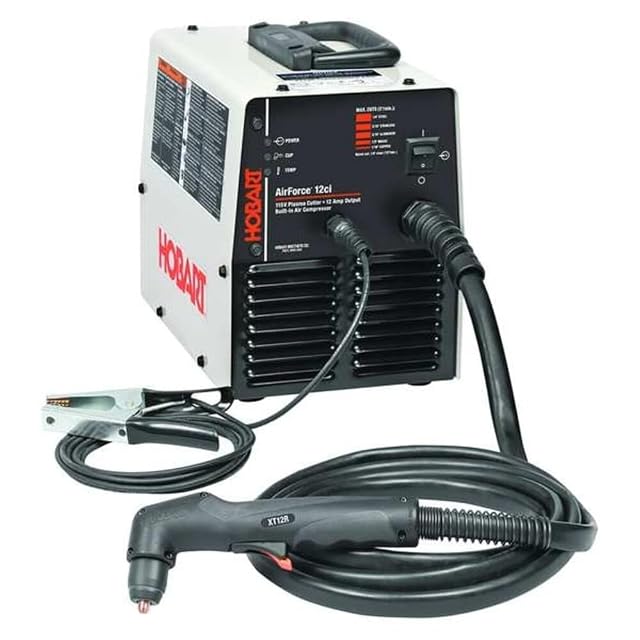
A plasma cutter with its own compressor inside — no bottle, no hose, no water trap — and a listing that publishes neither a cut thickness nor an amperage.
Best for: Cutting thin steel anywhere there is a socket, with nothing else to carry