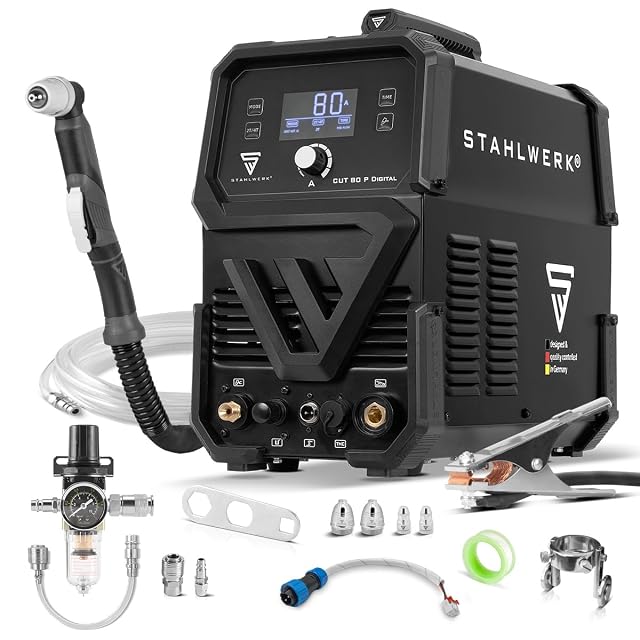
Where we come out The cheapest cutter here that tells you what it does on stainless and aluminum, not just on steel.
Three hundred and thirty dollars, 15 to 45 A, and the specification the two cheaper machines on this page omit: cut thickness for three materials.
Fifteen, eight, five
Fifteen millimeters in ST37 mild steel. Eight in V2A or V4A stainless. Five in aluminum. Those three figures tell you far more than « 50 A » ever could, and the spread between them is not a defect — it is physics. Stainless holds heat in the kerf; aluminum carries it away faster than the arc can put it in. Any machine quoting a single number is quoting the mild steel one.
They are also severance figures in the usual sense: the thickest the machine will get through. Plan on cutting cleanly at roughly two thirds — call this a comfortable 10 mm (0.39 in) machine in steel.
HF pilot ignition
Contactless starting, so painted, coated and rusty surfaces light without scratching for a spot of bare metal. As with every pilot machine, the discipline is not to idle with the arc burning off the work.
The trade against the cheaper machines
The VEVOR pair above cost €173 and €220 and publish their air timings but no thicknesses. This one publishes thicknesses and not its flow timings. Between the two, thickness by material is the number that decides whether the machine suits your work — timings decide how long tips last, which is a running cost rather than a capability.
Sources
Cutting current, supply, cut thicknesses, ignition and materials come from the manufacturer’s published specification. No duty cycle is stated there, and none is invented here. Market availability was verified per market on the EAN.
Prices quoted in this text were read on 2026-08-13. The live price is at the top of the page.
What it handles, and what it will not
Strengths
Three cut thicknesses published, by material — the only honest way to quote a plasma cutter
HF pilot ignition, so painted and rusty steel start reliably
230 V supply and live on all six markets
Compromises
45 A maximum, so 15 mm (0.59 in) is the real ceiling in steel
No duty cycle published
Aluminum at 5 mm (0.20 in) is a reminder that plasma is a steel tool first
Specifications
Cutting current
15–45 A
Supply
230 V
Cut thickness
15 mm (0.59 in) mild steel (ST37), 8 mm (0.31 in) stainless (V2A/V4A), 5 mm (0.20 in) aluminum
Arc
HF pilot ignition, contactless
Materials
Mild steel, stainless, aluminum — including painted and coated surfaces
Part number
6928
Amazon reference
B0GD155BWX
EAN
4262452499283
The questions welders ask
Why do the three materials differ so much?
Because plasma cuts by melting metal and blowing it away, and the three behave differently. Stainless conducts heat poorly and holds it in the cut, so the edge oxidizes and the maximum falls. Aluminum conducts heat away so fast that much of the energy leaves the cut zone, which is why the figure is a third of the steel one. A single « cuts up to X mm » number always describes mild steel.
Should I buy for the maximum thickness?
No — buy for about two thirds of it. The quoted figure is the thickest the machine will sever; the thickness it will cut cleanly, quickly and without dross is meaningfully less. A machine rated at 15 mm (0.59 in) is a comfortable 10 mm (0.39 in) machine, and that is the number to compare against your work.
Our score
8.1/ 10
The cheapest cutter here that tells you what it does on stainless and aluminum, not just on steel.
Price and availability, for welding machines
A reference exists on these Amazon stores: France, Germany, Italy, Spain, United Kingdom, United States. Listed is not the same as in stock — availability changes daily.
Details checked on August 13, 2026.
Who this one is for, among welding machines
A workshop cutting steel plate and section up to about 10 mm (0.39 in), cleanly
Specifications: the manufacturer sheet for welding and metalworking machines and the matching Amazon product page. Prices and availability: Keepa. Every figure on this page names its source.
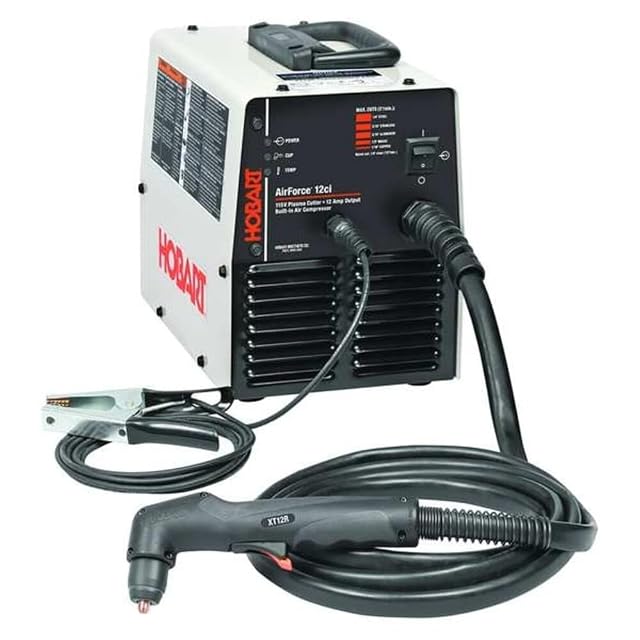
A plasma cutter with its own compressor inside — no bottle, no hose, no water trap — and a listing that publishes neither a cut thickness nor an amperage.
Best for: Cutting thin steel anywhere there is a socket, with nothing else to carry