Skip to content

Helucidy JJ-1001

The only extractor in this hub, either half, that publishes a filter class — and the only one that grades its carbon by iodine value.

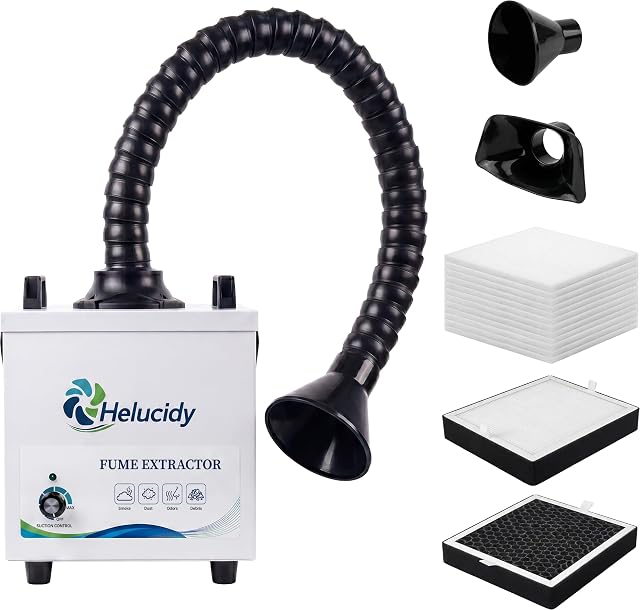
Helucidy three-layer fume extractor with its H13 filter and capture hood

Helucidy JJ-1001

The only extractor in this hub, either half, that publishes a filter class — and the only one that grades its carbon by iodine value.

Amazon reference
B0GCH96T9Q
EAN
0792105532370
  • Publishes a filter class — H13 HEPA — which no other extractor in this hub states
  • Grades its carbon filter by iodine value, 800 to 1000 mg/g, which is how adsorption capacity is actually specified
  • The highest price in the American half of this hub, for a bench unit rather than an arm

Best for: Bench work where the fume is fine particulate and the filter grade has to be known, not assumed

≈ $300
Check price on Amazon
Specifications

Amazon reference
B0GCH96T9Q
EAN
0792105532370

This hub’s introduction compares three things: airflow, filter class, and how close the capture point sits to the arc. Of the five extraction products already published here, not one states a filter class. This listing states H13 — a grade from the EN 1822 series, meaning at least 99.95 per cent retention at the most penetrating particle size — and backs it with an efficiency figure that carries a particle size with it: 99.97 per cent at 0.3 µm.

It goes further than any other page on this shelf in one more place. The carbon main filter is graded by iodine value, 800 to 1000 mg/g, which is how adsorption capacity is specified rather than described. Twelve pre-filter pads come in the box and the main element is given a life of 120 to 180 days in normal use — a figure the two STAHLWERK consumables on this shelf explicitly do not publish for themselves.

Against that, the airflow is lower than the cheaper VEVOR next to it: 250 m (820 ft)³/h from a 100 W brushless motor, against 280 from 150 W. That is what a tighter filter does to a smaller motor, and it is the trade being offered — grade against volume. Two small things on the page are worth noticing: the compliance bullet spells RoHS as “ROSH”, and a closing note warns that “New and old packaging will be shipped randomly”.

Availability

Read on the day this page was built: $300 at the American Amazon shop.

Read from Keepa on the day this page was last revised; stock and price both move without notice.

Prices quoted in this text were read on 2026-10-07. The live price is at the top of the page.

The questions welders ask

What does H13 mean, and why does it matter here?

It is a filter grade from the EN 1822 series: an H13 element retains at least 99.95 per cent of particles at the most penetrating size. This hub compares extractors on airflow, filter class and capture distance — and until this listing, no extractor in either half of the shelf published a class at all. Three-stage, HEPA and 99.9-something per cent are all claims; H13 is a specification with a standard behind it.

What is an iodine value on a carbon filter?

The standard measure of how much an activated carbon can adsorb — milligrams of iodine per gram of carbon. Helucidy publishes 800 to 1000 mg/g, which is the ordinary range for a good general-purpose carbon. It matters because carbon is the stage that handles gases and smells, and a listing that merely says "activated carbon" is describing a material rather than a capacity. No other extractor in this hub grades its carbon.

Does more filtration mean less airflow?

Always, and that is the trade here. This unit publishes 250 m (820 ft)³/h from 100 W; the VEVOR beside it publishes 280 m (919 ft)³/h from 150 W with no filter class. Tighter media resists more air, so a graded H13 element on a smaller motor arriving at a lower figure is consistent rather than contradictory. Which matters more depends on the fume: fine particulate wants the grade, volume of smoke wants the flow.

All fume extraction