Makes blades instead of buying them — 18 mm (0.71 in) maximum
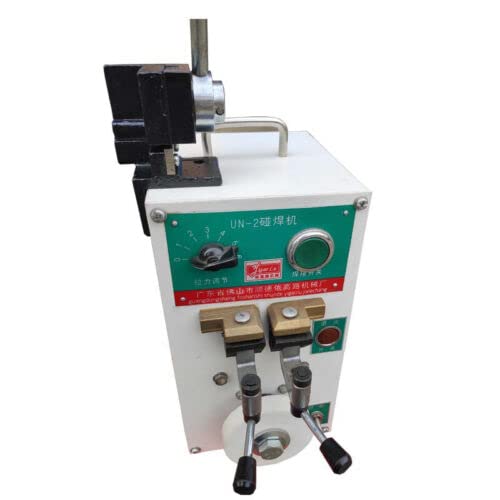
Canglan Technology UN-2 band blade butt welder
The machine that turns a coil of blade stock into loops of any length, rated in the same unit as the blades themselves — and whose own listing states its power as 2 kW and then 2,000 kW.
Every other product on this shelf is a blade. This is the machine that makes them. A band saw takes one specific loop length, which is why the five European blades published here come in five different lengths — 1,435, 1,440, 1,620, 1,638 and 1,735 mm (68.3 in). A butt welder plus a coil of blade stock replaces all of them: cut to length, weld, temper, and the same stock serves every saw in the workshop. It also repairs a blade that has snapped at the joint rather than worn out, which is how most band blades actually die.
The figure that decides compatibility is published, and it is in this shelf’s own unit: a maximum welding width of 18 mm (0.71 in), against the 13 mm (0.51 in) bands on this page. The tempering cycle matters just as much — a butt weld quenched in the clamps is hard and brittle, and a brittle joint in a blade bending round two wheels fails quickly, so reheating it to restore toughness is the difference between a working blade and a broken one. Voltage, power, dimensions and weight are all given: 220 V at 50 Hz, 2 kW, 240 by 150 by 320 mm (12.6 in), 10 kg (22 lb) gross.
Two things to settle before buying. The supply is 220 V at 50 Hz, which is not a North American domestic circuit, on a listing sold in the United States. And the description cannot agree with itself about the power: the specification block says 2 kW, and a marketing line two rows below begins “2000KW Welding Machine Mini Butt Welders” — two megawatts, from a ten-kilogram box.
Availability
Read on the day this page was built: $693 at the American Amazon shop.
Read from Keepa on the day this page was last revised; stock and price both move without notice.
Prices quoted in this text were read on 2026-10-07. The live price is at the top of the page.
The questions welders ask
Why would anyone weld their own blades?
Length and cost. A band saw takes one specific loop length, so every saw in a workshop needs its own blade stock — and the five European blades published on this shelf come in 1,435, 1,440, 1,620, 1,638 and 1,735 mm (68.3 in), which is five different purchases. Bulk coil plus a butt welder makes any length from one stock, and it repairs a blade that has snapped at the weld rather than worn out. The 18 mm (0.71 in) maximum width here covers every 13 mm (0.51 in) band on this shelf.
What is the tempering cycle for?
It is what makes the weld usable. Butt welding heats the two ends to fusion and quenches them in the clamps, which leaves the joint hard and brittle — and a brittle joint in a blade that bends round two wheels thousands of times a minute breaks. A tempering cycle reheats the weld to a lower temperature to restore toughness. A welder without one is a machine for making blades that fail at the join.
Is it 2 kW or 2,000 kW?
Two kilowatts. The specification block states "Power: 2KW" alongside 220 V at 50 Hz, which is consistent — 2 kW at 220 V is about 9 amps. The marketing line two rows below opens "2000KW Welding Machine Mini Butt Welders", which would be two megawatts in a 10 kg (22 lb) box. It is a factor of a thousand, and it sits in the same description as the correct figure.