Skip to content

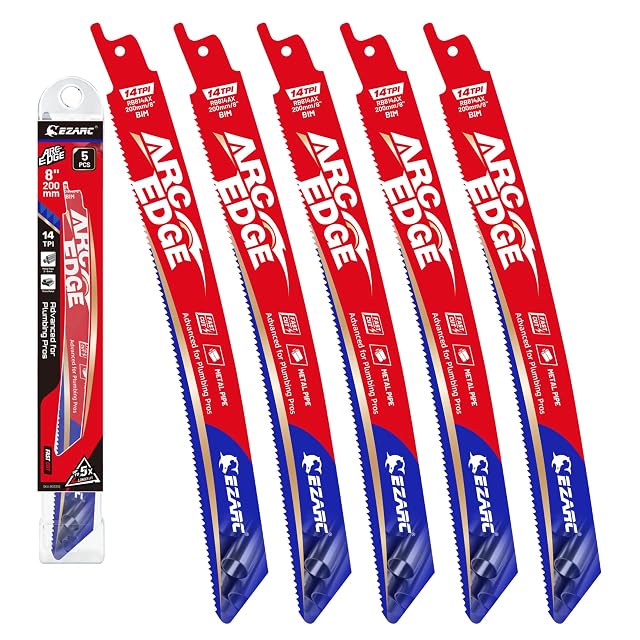
EZARC 802302, arc edge 8 in 14 TPI, 5-pack

The only blade on this shelf whose edge is curved rather than straight — a design aimed squarely at the three-teeth rule this hub is built on.

EZARC arc edge reciprocating saw blade with its curved cutting edge

EZARC 802302, arc edge 8 in 14 TPI, 5-pack

The only blade on this shelf whose edge is curved rather than straight — a design aimed squarely at the three-teeth rule this hub is built on.

Amazon reference
B0H6WRG1GG
EAN
0810151454108
  • A curved edge, stated to engage about 110 per cent more teeth than a straight blade
  • Variable tooth height, stated to improve chip clearance and heat dissipation
  • A curved edge cannot start a cut flush against a surface the way a straight one can

Best for: Thin-wall tube, where tooth engagement is the whole problem

≈ $21
Check price on Amazon
Specifications

Amazon reference
B0H6WRG1GG
EAN
0810151454108

Every other blade on this shelf has a straight edge. This one is curved, and the reason is the rule this hub is built on: keep at least three teeth in the cut. On thin-wall tube a straight blade crossing a round section has almost no teeth engaged as it enters and leaves, which is exactly when a tooth catches the far wall and strips. Curving the edge keeps more of it in contact for more of the stroke, and EZARC puts the gain at about 110 per cent more teeth engaged.

Two other details follow the same logic. The shank is angled 6 degrees, which turns part of the saw’s thrust into a downward force that keeps the teeth biting rather than skating. And the tooth height alternates, so the gullets clear chips rather than packing — which is the other half of the hub’s warning, where too many teeth in the cut burns instead of cutting.

The figures are published properly: M42 high speed steel with 8 per cent cobalt, 14 TPI nominal, 8 in overall with 4.72 in of actual cutting edge, and a material range of 2 to 6 mm (0.08 to 0.24 in) tubing. That range is narrower than the straight blades here claim, which given what the blade is designed for reads as honesty rather than weakness. The one thing a curved blade cannot do is start a cut flush against a flat surface.

Availability

Read on the day this page was built: $20 at the American Amazon shop.

Read from Keepa on the day this page was last revised; stock and price both move without notice.

Prices quoted in this text were read on 2026-10-07. The live price is at the top of the page.

The questions welders ask

Why curve the edge?

To fight the three-teeth rule. This hub’s buying tip is that too few teeth in the cut lets a tooth catch the far edge and strip — and on thin-wall tube, a straight blade crossing a round section has barely any teeth in contact at the start and end of each stroke. A curved edge wraps the work slightly, so more teeth are engaged through more of the stroke. EZARC puts the gain at about 110 per cent more teeth engaged, which is a claim rather than a measurement, but the mechanism is sound and it is aimed at precisely the failure this shelf exists to explain.

What does the effective cutting length tell me?

How much blade you actually get. The blade is 8 in overall and 4.72 in of that is toothed cutting edge; the rest is shank and the transition. Few listings publish both figures, and it is the second one that decides whether the blade will reach through your work. On this shelf the TOLESA blades publish only the overall length and give a maximum pipe diameter instead, which is the same information arrived at differently.

All metal saw blades