Skip to content

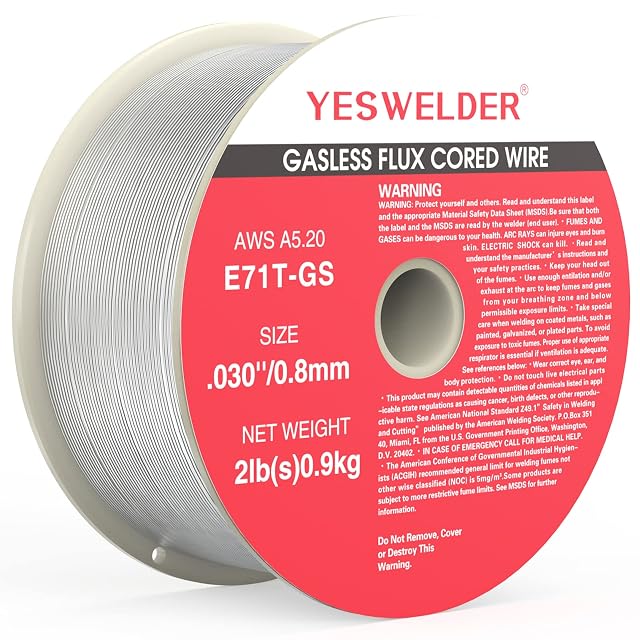
YESWELDER E71T-GS gasless, 0.030 in, 2 lb

The only flux-cored wire in this hub, and its listing says nothing about the polarity change this hub’s own introduction warns about.

YESWELDER gasless flux-core MIG wire on a two-pound spool

YESWELDER E71T-GS gasless, 0.030 in, 2 lb

The only flux-cored wire in this hub, and its listing says nothing about the polarity change this hub’s own introduction warns about.

Amazon reference
B07W41G6P3
EAN
0658848701643
  • Needs no shielding gas, which is what makes outdoor and windy work possible at all
  • Stated to weld over light rust and mill scale, where solid wire under gas will not
  • Says nothing about polarity, and self-shielded flux-cored wire normally runs electrode negative — the reverse of solid wire

Best for: Outdoor and windy work, or a machine with no gas bottle at all

≈ $17
Check price on Amazon

Specifications

Amazon reference
B07W41G6P3
EAN
0658848701643

This is the only wire in this hub that works without a gas bottle, and that single property decides who should buy it. Outdoors, in a draft, or on a machine that has never had gas on it, solid wire under gas simply does not work — the shielding blows away and the weld goes porous. A self-shielded flux-cored wire carries its own shielding in the flux, which is why it is the farm-gate and field-repair wire.

The listing is sound on what the wire does: all positions, over light rust and mill scale, low spatter for its type, a slag that lifts, and an ABS spool built for a wire feeder rather than a bare coil. Two pounds is a small spool, which suits a machine that only occasionally runs gasless.

What it does not mention is the thing this hub’s introduction singles out. Self-shielded flux-cored wire normally runs with the polarity reversed — electrode negative, where solid wire runs electrode positive — and a machine left on its solid-wire setting produces a fierce, wandering, spattery arc that gets blamed on the wire every time. Nothing on this page says it. It is the first thing to check in your machine’s manual before the spool goes on.

Availability

Read on the day this page was built: $17 at the American Amazon shop.

Read from Keepa on the day this page was last revised; stock and price both move without notice.

Prices quoted in this text were read on 2026-10-07. The live price is at the top of the page.
The questions welders ask

Do I need to change the polarity?

Almost certainly, and the listing does not say so. This hub’s introduction names it as "the detail that ruins a first attempt: flux-cored wire usually needs the polarity reversed". Solid wire under gas runs electrode positive; self-shielded flux-cored wire normally runs electrode negative, and a machine left on the solid-wire setting gives a spattery, wandering arc that most people blame on the wire. Check your machine’s manual for the gasless setting before loading this spool — nothing on the page mentions it.

Is 0.030 in the same as 0.8 mm (0.03 in)?

Near enough that the trade uses them interchangeably, and not exactly. 0.030 in is 0.76 mm (0.03 in); a true 0.8 mm (0.03 in) wire is 0.031 in. The listing gives both figures on the same line, as most do. What matters more is this hub’s buying tip: match the diameter to the thinnest metal you weld. At 0.030 in this is a general-purpose size, comfortable from about 2 mm (0.08 in) upwards and clumsy on car-body sheet.

All mig wire