Skip to content

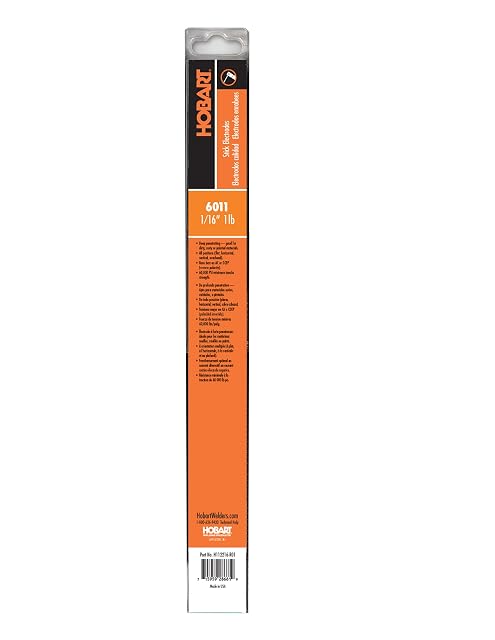
Hobart H112216-R01, 6011, 1/16 in

A deep-penetrating 6011 in the smallest diameter on this shelf, stated for welding through light to medium dirt, rust and paint.

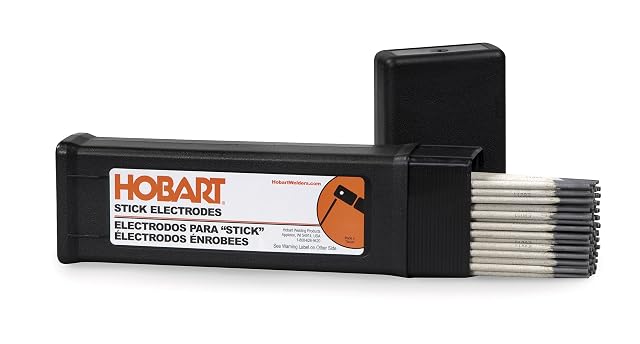
Hobart 6011 stick electrodes, 1/16 inch, in their one-pound pack

Hobart H112216-R01, 6011, 1/16 in

A deep-penetrating 6011 in the smallest diameter on this shelf, stated for welding through light to medium dirt, rust and paint.

Amazon reference
B004USV1RE
EAN
0715959286619
  • Stated for welding through light to medium dirt, rust and paint — the one job a clean-metal rod cannot do
  • Publishes a tensile strength: 60,000 PSI
  • A cellulosic coating gives a fierce, spattery arc — this is not a rod to learn on

Best for: Farm and repair work on steel that cannot be cleaned first

≈ $16
Check price on Amazon

Specifications

Amazon reference
B004USV1RE
EAN
0715959286619

Every rod on this shelf assumes clean metal except this one. A 6011 has a cellulosic coating that burns hard and digs, which is how it welds through light to medium rust, paint, mill scale and galvanizing — and Hobart states that use directly rather than leaving it to be inferred. On a gate hinge or a trailer frame that cannot be taken to a wire wheel, it is the only honest choice here.

The specification is modest and published: 60,000 PSI tensile strength, all positions, AC or DC electrode positive, carbon and galvanized steel, one pound of 1/16 in. That diameter is the smallest on this shelf and the most useful on a small inverter, because it lights and runs inside the current range such a machine can really hold.

What you accept with a 6011 is the arc. It spatters, it is loud, it leaves more to chip and grind than a rutile rod, and it punishes a long arc length. It is not the rod to learn on — the E6013 further down this shelf is, and this hub’s buying tip makes the same point about rutile being the forgiving choice. And as everywhere in this hub except one listing, no current range is published for the diameter in the box.

Availability

Read on the day this page was built: $16 at the American Amazon shop.

Read from Keepa on the day this page was last revised; stock and price both move without notice.

Prices quoted in this text were read on 2026-10-07. The live price is at the top of the page.
The questions welders ask

What is 6011 for, if 6013 is easier?

Dirt. A 6011 has a cellulosic coating that burns violently and digs deep, which blows through light rust, mill scale, paint and galvanizing to find clean metal underneath. A 6013 rutile rod on the same joint sits on top of the contamination and traps slag. The trade is an aggressive, spattery arc that is harder to control and leaves more cleaning up. For a farm repair on steel you cannot wire-brush, it is the right rod and the easy one is the wrong one.

Why is 1/16 in useful?

Because it strikes and runs at a current a small machine can actually deliver, and because it will not blow straight through thin section. On this shelf the other diameters are 3/32 and 5/32 in; 1/16 in is for sheet and for the low end of a 100-amp inverter’s range. What the listing does not give is the current window — the cheapest rods on this shelf publish 25 to 40 A for this diameter, which is the figure to start from.

All stick electrodes