Where we come out The only machine on this shelf that changes speed for the cutter and takes both annular cutters and twist drills — on a page that publishes neither its speeds nor its magnet.
This is the professional end of the shelf and the specification that justifies it is the gearbox. A magnetic drill is used with annular cutters from about 12 to 50 mm (0.47 to 1.97 in), and the correct speed falls as the cutter grows — this hub’s buying tip puts a 25 mm (0.98 in) cutter well under 500 rpm. One fixed speed is therefore right at one diameter and wrong everywhere else, which is the single biggest limitation of the cheaper machine on this shelf. Two speeds halves that problem.
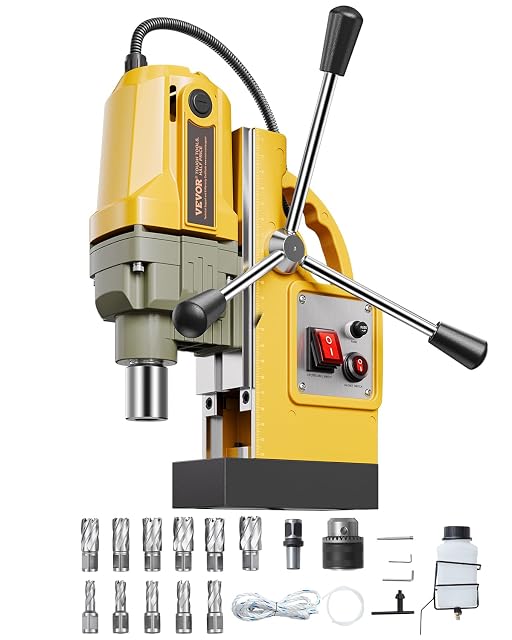
The second real advantage is the quick-change head. A 3/4 in Weldon shank takes annular cutters for large cored holes; a 1/2 in keyed chuck takes ordinary twist drills for small ones; and the change needs no tools, so the same machine drills a pilot and then cores a 50 mm (1.97 in) hole without coming off the beam. Four inches of travel is twice the quill travel of any bench press here, and the feed handles swap sides for working against an obstruction. A magnetic coolant bottle sits wherever there is steel to stick it to.
What the page does not contain is anything about the magnet. No holding force, no minimum plate thickness, no base dimensions — on a tool that is held to the work by nothing else. The cheaper VEVOR on this shelf publishes all three. Nor are the two speeds given as numbers, which on a machine whose chief advantage is having two of them is a strange omission.
Availability
Read on the day this page was built: $1000 at the American Amazon shop.
Read from Keepa on the day this page was last revised; stock and price both move without notice.
Prices quoted in this text were read on 2026-10-07. The live price is at the top of the page.
What it handles, and what it will not
Strengths
Two speeds, which is the specification this hub’s buying tip asks for — the slower one for the big cutters
A 2 in cutter capacity, nearly 51 mm (2.01 in), the largest on this shelf
Four inches of travel, twice the quill travel of any bench press here
Tool-free change between a 3/4 in Weldon shank and a 1/2 in keyed chuck, so it takes both annular cutters and ordinary drills
Overload protection electronics stated, to stop the motor rather than burn it
A magnetic coolant bottle that can sit on either side or on the work
Quick-release feed handles that swap to either side of the tool
Compromises
The two speeds are not published anywhere on the listing
No magnet holding force published, where the cheaper machine on this shelf states 2,810 lbf
No minimum plate thickness published, which is the figure that decides whether the magnet will hold
By a wide margin the most expensive machine in this hub
No weight published for a tool carried up scaffolding
Specifications
Amazon reference
B00N3HSVXK
EAN
0885911375962
The questions welders ask
Why does two speeds matter so much on a mag drill?
Because annular cutter sizes vary by a factor of four and the right speed varies with them. This hub’s buying tip says a 25 mm (0.98 in) cutter wants far less than 500 rpm; a 12 mm (0.47 in) cutter wants perhaps three times that. A single-speed machine is correct at one diameter and wrong at the others — the VEVOR drill on this shelf runs at 800 rpm fixed with a 40 mm (1.57 in) capacity. Two speeds does not solve the problem completely, and it halves it.
What does the Weldon and chuck combination buy?
Both kinds of hole. An annular cutter has a 3/4 in Weldon shank with flats for the driving screws and cuts a slug out of the middle, which is how large holes in structural steel are made; a 1/2 in keyed chuck takes ordinary twist drills for small holes. Changing between them without tools means one machine covers 4 mm (0.16 in) pilot holes and 50 mm (1.97 in) cored holes on the same beam. No other machine on this shelf does both.
What is missing from the page?
The magnet. There is no holding force, no minimum plate thickness and no base size anywhere on the listing — and a magnetic drill is entirely dependent on all three. The far cheaper VEVOR on this shelf publishes 2,810 lbf, 12,500 N and a 10 mm (0.39 in) minimum plate. The two speeds are not given as figures either, on a machine whose main advantage over that VEVOR is having two of them.
The two nearest machines on price
Same shelf, nearest price — what else that money puts on the bench.
Structural steel on site, where the cutter size changes and the speed has to change with it
What buyers actually choose
Amazon reports what buyers took in the month before this page was last checked: at least 50.
The figure is a floor, rounded by Amazon, and read through Keepa — it says what buyers picked, not what a maker claims.
Sources
Specifications: the manufacturer sheet for welding and metalworking machines and the matching Amazon product page. Prices and availability: Keepa. Every figure on this page names its source.