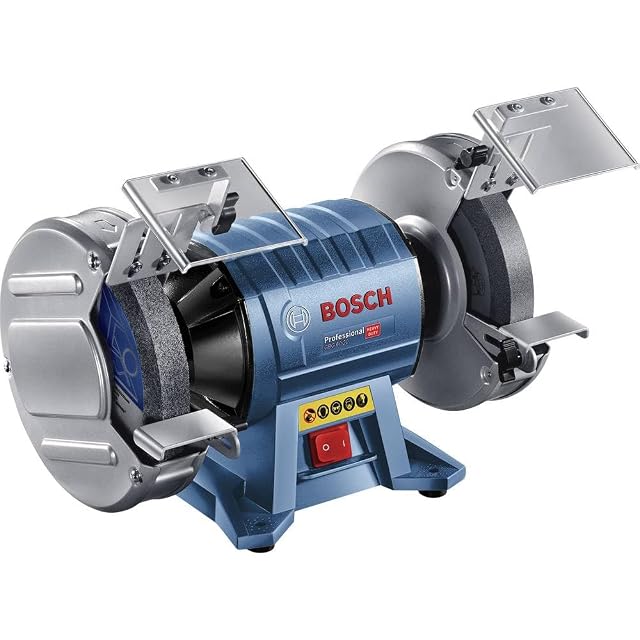
Where we come out The only machine here that cannot ruin a chisel, and the one whose tank you must remember to empty.
A hundred and twenty-two euros for two stations on one base: a 200 mm (7.87 in) wheel running through water and a 150 mm (5.91 in) dry wheel.
Water is the whole point
A dry wheel at 2,980 rpm puts heat into a thin edge faster than the steel can shed it. Above roughly 200 °C (392 °F), hardened tool steel begins to soften — and the visible sign, a straw or blue tint at the very tip, means that part of the tool is now unhardened and will not hold an edge. The only remedy is to grind it away and start again.
A wheel turning through a water bath cannot get there. You can sharpen a chisel, a plane iron, a turning gouge or a kitchen knife with the tool in constant contact and no anxiety at all. It is slower than dry grinding, which is exactly why it is safe.
The dry side is the shaping side
Rough work — reshaping a bevel, taking a nick out — belongs on the 150 mm (5.91 in) dry wheel, quickly and with dips in water. The wet wheel then takes it to an edge.
The habit you have to acquire
Empty the tank after use. A wheel left standing in water soaks it up on the submerged side, becomes heavier and softer there, and runs out of balance from then on. Drain it, spin it dry for a moment, and it will stay true.
Sources
Wheel diameters, power, speed and tank material come from the manufacturer’s published specification. Market availability was verified per market on the EAN.
What it handles, and what it will not
Strengths
The wet wheel removes the risk of drawing the temper — the failure that ruins tools
Both a wet and a dry station on one machine
A stainless tank rather than a painted one that rusts through
Compromises
Not sold on the American or Spanish stores at the time of checking
The dry side is only 150 mm (5.91 in), so the flatter grind is on the wet wheel — which is slow
Wet wheels need the water emptied after use, or the wheel stands in it and goes soft on one side
Specifications
Wet wheel
Ø 200 mm (7.87 in), running in water
Dry wheel
Ø 150 mm (5.91 in)
Power
250 W
Speed
2,980 rpm
Water tank
Stainless steel
Amazon reference
B0FD8ZK589
EAN
9004853610356
The questions welders ask
What does « drawing the temper » actually mean?
Hardened tool steel loses its hardness when it gets hot — from around 200 °C (392 °F) the structure changes and the edge becomes soft. On a thin edge that happens in seconds on a dry wheel, and the tell-tale is a straw or blue color on the very tip. Once it has happened, grinding back past the discoloured metal is the only fix. A wheel running through water cannot reach that temperature.
Do I have to empty the tank?
Yes, every time. A wheel left standing in water absorbs it on the submerged side, which makes that side heavier and softer — the wheel then runs out of balance and wears unevenly. Drain the tank when you finish, and let the wheel spin dry for a moment before you put the guard back.
Our score
8.1/ 10
The only machine here that cannot ruin a chisel, and the one whose tank you must remember to empty.
Price and availability, for welding machines
A reference exists on these Amazon stores: France, Germany, Italy, United Kingdom. Listed is not the same as in stock — availability changes daily.
Details checked on August 13, 2026.
Who this one is for, among welding machines
Sharpening chisels, plane irons, turning tools and knives without blueing them
Specifications: the manufacturer sheet for welding and metalworking machines and the matching Amazon product page. Prices and availability: Keepa. Every figure on this page names its source.