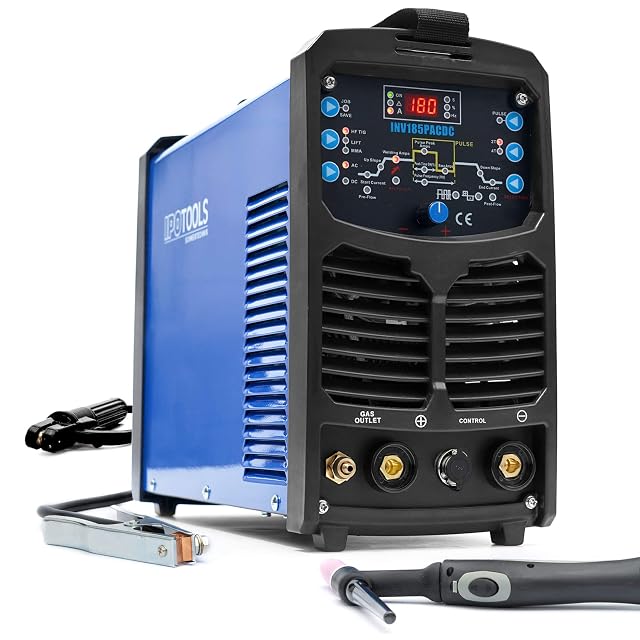
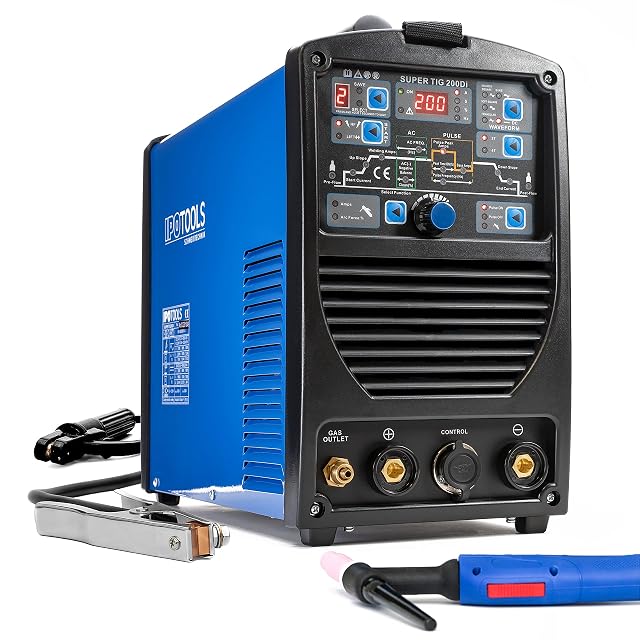
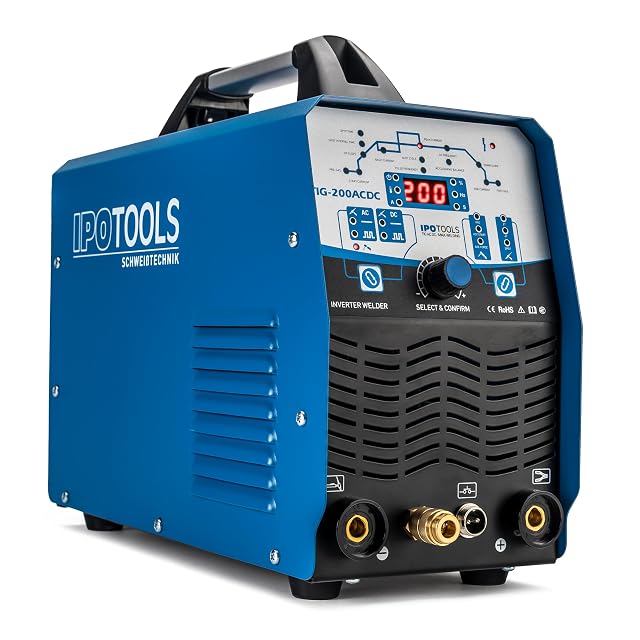
Where we come out The right machine for stainless, and the wrong one for anyone who might buy aluminum next year.
Four hundred and forty dollars for a DC-only machine, when €383 elsewhere on this page buys AC/DC. That looks like poor value until you read what STAHLWERK spent the money on.
Two pulse regimes
Most machines have one pulse setting. This one publishes two: a long pulse for deeper penetration and a short pulse for reduced heat input. Those are different tools. Slow, heavy pulsing lets the weld pool freeze slightly between peaks, which is how you hold a bead on thin stainless without dropping through it and where the ripple pattern comes from. Fast pulsing tightens the arc column, concentrating energy into a narrower, deeper bead.
A stainless fabricator uses both, on different jobs, in the same afternoon.
Its honesty about aluminum
The listing states that the machine suits stainless, steel and copper, and explicitly not aluminum. That deserves noting, because it would have been easy to leave the sentence out and let the buyer discover it. Aluminum needs alternating current to break its oxide layer; a DC machine cannot, and no consumable changes that.
Who it is for
If aluminum is not in your work, this is a better machine for the money than a mid-range AC/DC — the budget went into the arc rather than into a mode you would never use. If there is any chance aluminum arrives later, buy AC/DC now: this capability cannot be added.
Sources
Current, process, pulse modes, arc start, trigger modes and the material list come from the manufacturer’s published specification. Market availability was verified per market on the EAN; the reference was not live on the American store at the time of checking.
Prices quoted in this text were read on 2026-08-13. The live price is at the top of the page.
What it handles, and what it will not
Strengths
Two distinct pulse regimes rather than one, chosen for penetration or for heat control
The listing states plainly that it is not for aluminum — a rare piece of honesty
HF start and 2T/4T, verified on five markets
Compromises
€440 for a DC machine when €383 buys AC/DC elsewhere on this page
No aluminum, and no way to add it
No published duty cycle
Specifications
Current
200 A
Process
DC TIG, MMA
Pulse
Long pulse for deeper penetration, short pulse for reduced heat input
Arc start
HF, contactless
Trigger modes
2T / 4T
Materials named by the maker
Stainless, steel, copper — explicitly not aluminum
Amazon reference
B0BHF6G94P
EAN
4260294081161
The questions welders ask
Why buy DC only at this price?
Because if you weld stainless and steel, AC does nothing for you and pulse control does a great deal. A machine that spends its budget on two pulse regimes and a stable low-amp arc will serve a stainless fabricator better than an AC/DC machine of the same price that spreads the money thinner. The question is not which machine is better, it is whether aluminum is in your work.
What is the difference between long and short pulse?
Frequency, and what it is for. Slow pulsing — a beat you can hear — is used to control the pool on thin material and gives the stacked-coin appearance; the arc puts in heat, then lets it fall. Fast pulsing stiffens and narrows the arc, which concentrates penetration into a narrower bead. Having both means you choose between depth and heat control rather than accepting one compromise.
Our score
7.8/ 10
The right machine for stainless, and the wrong one for anyone who might buy aluminum next year.
Price and availability, for welding machines
A reference exists on these Amazon stores: France, Germany, Italy, Spain, United Kingdom. Listed is not the same as in stock — availability changes daily.
Details checked on August 13, 2026.
Who this one is for, among welding machines
Stainless fabrication, where AC is useless and pulse control is everything
Consumables confirmed for this machine
Here because the consumable states this machine by name.
Specifications: the manufacturer sheet for welding and metalworking machines and the matching Amazon product page. Prices and availability: Keepa. Every figure on this page names its source.