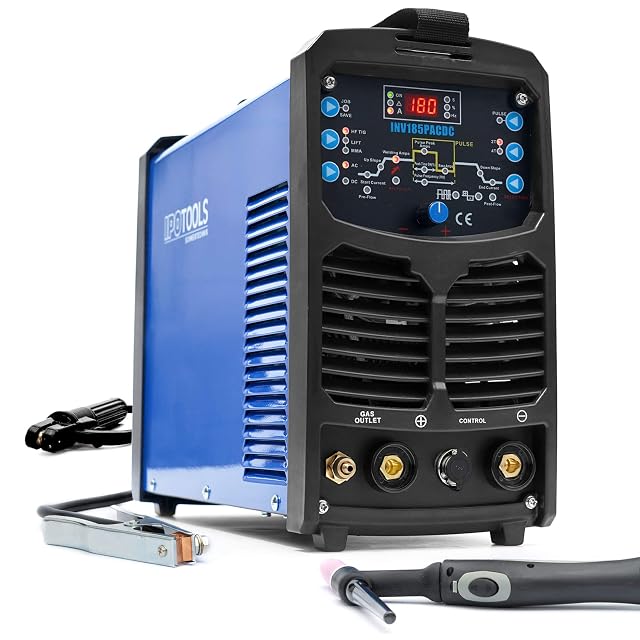
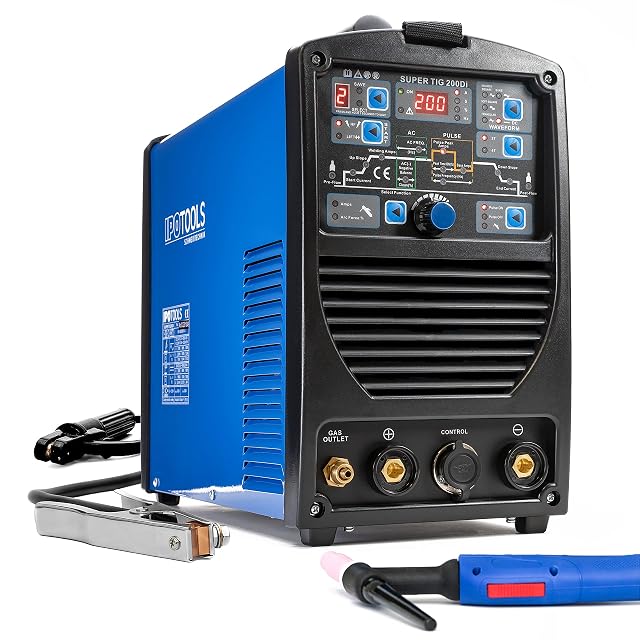
Where we come out The first machine here with the aluminum controls written on the label rather than implied.
Every AC/DC machine above this one on the page welds aluminum. This is the first that publishes the numbers that decide how well — AC frequency, pulse frequency on both currents, and a timed spot mode.
AC frequency, and why it is on the label
Alternating current breaks aluminum’s oxide layer. How fast it alternates changes the shape of the arc: low frequency gives a broad, soft cone that suits heavy sections, high frequency tightens it into a focused point that goes where you aim. A range of 20 to 100 Hz means you can weld a thick base plate and a thin fillet on the same afternoon without fighting the machine.
Machines that omit this figure usually fix it internally at around 50 Hz. That is a reasonable default and it is not adjustable, which you discover on the first job where the arc wanders.
Pulse, with actual ranges
0.1 to 99.9 Hz on DC and 0.5 to 99.9 Hz on AC. The low end is the slow, visible beat used to control a pool on thin material; the high end stiffens the arc. Publishing both ranges rather than the words « pulse function » is a small marker of a specification written by someone who welds.
The spot mode
Time and interval, from 0.01 to 9.99 seconds. Repeatable tacks are what stop thin sheet from pulling as it cools — the resolution is generous, the repeatability is the point.
What is still missing
No duty cycle at a stated temperature, and no AC balance range — the setting that decides how much of each cycle goes to cleaning the oxide rather than to penetration. At €459 both would be reasonable to expect.
Sources
Current, processes, pulse and AC frequency ranges, spot timing and warranty come from the manufacturer’s published specification. Market availability was verified per market on the EAN.
Prices quoted in this text were read on 2026-08-13. The live price is at the top of the page.
What it handles, and what it will not
Strengths
AC frequency adjustable from 20 to 100 Hz — this is what focuses the arc on aluminum
Pulse frequency published for both currents, with real ranges rather than « pulse function »
Live on all six markets, with a seven-year warranty behind it
Compromises
€459 — the point at which a TIG machine stops being an impulse purchase
No published duty cycle at a stated ambient temperature
The AC balance range is not published, only the frequency
Specifications
Current
200 A
Processes
AC and DC TIG with HF start, MMA
Pulse frequency
0.1–99.9 Hz on DC, 0.5–99.9 Hz on AC
AC frequency
20–100 Hz, adjustable
Spot mode
Time and interval adjustable, 0.01–9.99 s
Warranty
7 years (IPO Technik-Handels GmbH, Friedrichshafen, DE)
Amazon reference
B0FHWBMLF6
EAN
4251395117576
The questions welders ask
What does raising the AC frequency do?
It narrows and stiffens the arc. At 50 Hz the arc is broad and soft, which suits wide beads on thick aluminum; at 100 Hz it tightens into a focused cone that puts the heat where you point it, which is what you want on a fillet or a thin edge. Being able to set it is the difference between a machine that welds aluminum and one that welds it where you intend.
Is a spot mode measured to a hundredth of a second serious?
It is a real control, and the resolution is mostly marketing. What matters is repeatability: a tack of 0.4 seconds every time holds a panel square, where hand-timed tacks vary enough to pull the work as they cool. The hundredths matter less than the fact that the number is a setting rather than your reflexes.
Our score
7.8/ 10
The first machine here with the aluminum controls written on the label rather than implied.
Price and availability, for welding machines
A reference exists on these Amazon stores: France, Germany, Italy, Spain, United Kingdom, United States. Listed is not the same as in stock — availability changes daily.
Details checked on August 13, 2026.
Who this one is for, among welding machines
Aluminum work where the arc has to be steered, not just switched on
Consumables confirmed for this machine
Here because the consumable states this machine by name.
Specifications: the manufacturer sheet for welding and metalworking machines and the matching Amazon product page. Prices and availability: Keepa. Every figure on this page names its source.