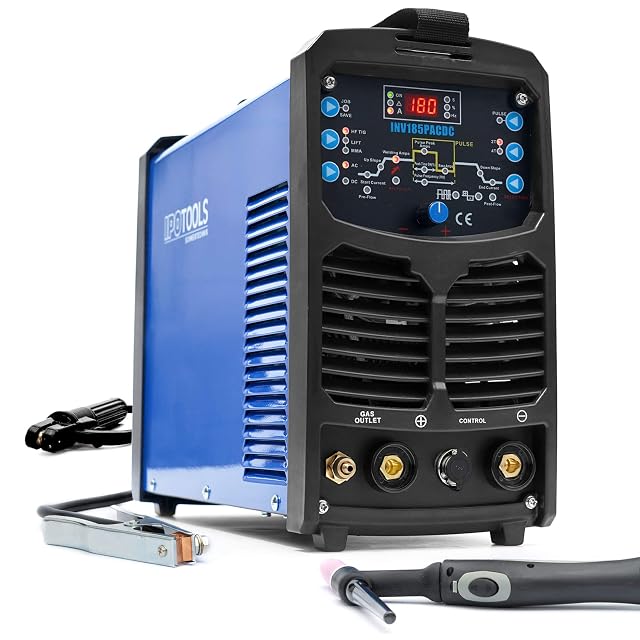
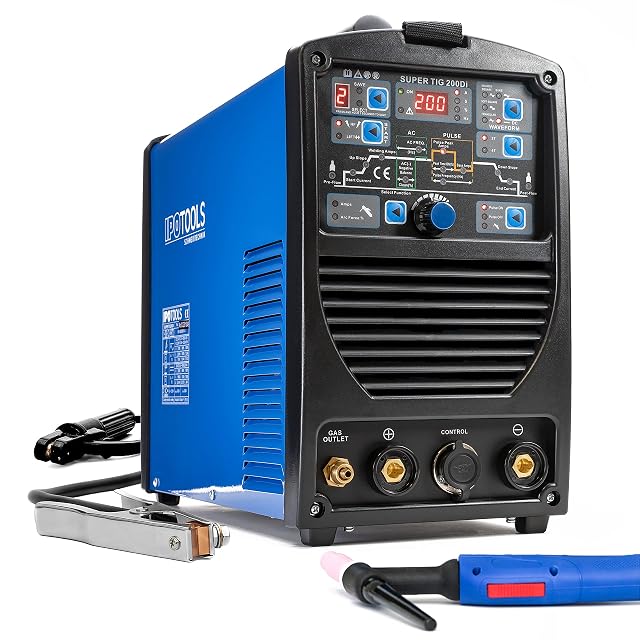
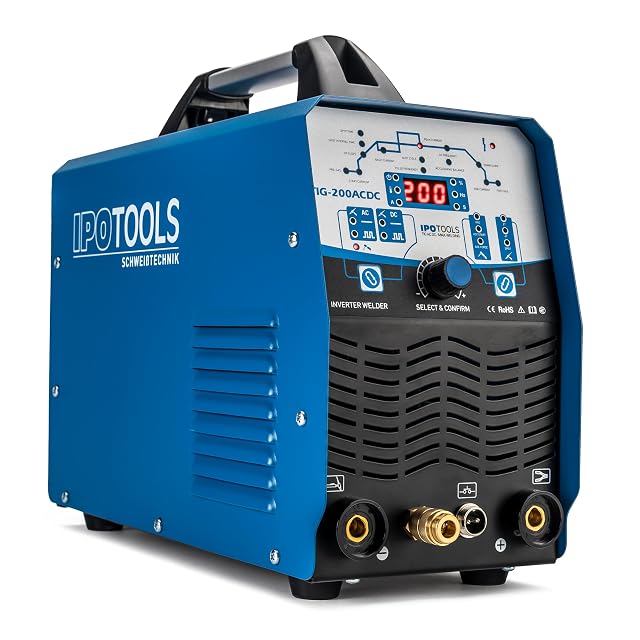
Where we come out A genuine, if narrow, TIG machine at the price of a good helmet.
At €128 this is the cheapest machine on the page, and it is honest about what it is: a DC lift-start TIG with an MMA mode, for steel, stainless and copper.
What lift start means in practice
You rest the tungsten on the work, press the trigger, and lift — the arc follows. There is no high-frequency burst, so nothing in the house complains, and there is no HF board to fail. The cost is that each start touches the electrode to the workpiece, which picks up a little contamination and means more regrinding than a machine with an HF start.
For a beginner that trade is often right. The commonest reason people abandon TIG is not the arc, it is the money spent before they have found out whether they enjoy the process.
The name is not the specification
It is sold as the TIG200 and rated at 140 A. That is enough for stainless up to roughly 3 mm (0.12 in) and steel a little thicker, which covers brackets, exhausts, tube frames and repairs. If you expected 200 A because of the model name, this is the first thing to know.
DC only
The maker names stainless, carbon steel, alloy steel and copper. Aluminum is absent, and correctly so: breaking the oxide layer on aluminum needs alternating current, which this machine does not produce. That is the single dividing line in TIG, and it is worth being sure which side of it you need before ordering.
Sources
Current, processes, arc start and material list come from the manufacturer’s published specification. Market availability was verified per market on the EAN; the reference was not live on the American store at the time of checking.
Prices quoted in this text were read on 2026-08-13. The live price is at the top of the page.
What it handles, and what it will not
Strengths
Lift start emits no high-frequency interference — nothing in the house gets upset
MMA included, which covers the outdoor and rusty-steel work TIG cannot
Compromises
DC only: no aluminum, ever, whatever the listing photographs suggest
Lift start contaminates the tungsten more readily than HF
The model is called TIG200 and rated 140 A — read the amperage, not the name
Specifications
Current
140 A
Processes
DC lift TIG, MMA
Arc start
Lift — no high frequency
Materials named by the maker
Stainless, carbon steel, alloy steel, copper
Part number
TIG200
Amazon reference
B0D44JNMXT
EAN
0644197796782
The questions welders ask
Why would anyone prefer lift start to high frequency?
Because HF is a burst of radio-frequency energy, and it interferes with electronics nearby — wireless networks, garage door receivers, sometimes the machine’s own display. In a home workshop attached to a house, lift start avoids the whole question. What you give up is tungsten life: touching the electrode to the work to strike leaves a trace of contamination each time.
Can it weld aluminum at all?
No. Aluminum carries an oxide layer that melts far hotter than the metal beneath it, and it is alternating current that breaks that layer up. A DC-only machine cannot do it, and no torch, gas or technique changes that. If aluminum matters, the AC/DC machines further down this page are the entry point.
Our score
7.2/ 10
A genuine, if narrow, TIG machine at the price of a good helmet.
Price and availability, for welding machines
A reference exists on these Amazon stores: France, Germany, Italy, Spain, United Kingdom. Listed is not the same as in stock — availability changes daily.
Details checked on August 13, 2026.
Who this one is for, among welding machines
Finding out whether you like TIG before spending €400 on one
Consumables confirmed for this machine
Here because the consumable states this machine by name.
Specifications: the manufacturer sheet for welding and metalworking machines and the matching Amazon product page. Prices and availability: Keepa. Every figure on this page names its source.