Skip to content

Fume extraction on a budget

Welding fume was classified as a Group 1 carcinogen by the IARC in 2017 — mild steel included, not only stainless. The exposure is cumulative and invisible, which is why extraction is the purchase everyone postpones. The good news is that placement matters more than power.

Welding fume was classified as a Group 1 carcinogen by the IARC in 2017 — mild steel included, not only stainless. The exposure is cumulative and invisible, which is why extraction is the purchase everyone postpones. The good news is that placement matters more than power.

Which welder suits your metal?

You weld a few minutes a month with the door open
Organized cross-ventilation that pulls the loaded air away from you beats a badly placed capture hood.
You weld regularly at the same bench
An extraction arm at source: it is the distance between the hood and the arc that decides everything, not the quoted airflow.
You weld galvanized steel or stainless
Source capture stops being a comfort. Zinc and hexavalent chromium do not dilute away in a workshop, they accumulate in it.
You move around the work
A powered air-purifying respirator rather than a fixed arm you will never reposition.

Picking by the metal

A fixed bench station

The favorable case: the arm is set once, stays within reach, and capture follows the work without you thinking about it.

Large parts on the floor

The arm no longer follows. This is where general ventilation and personal respiratory protection take over.

Welding galvanized steel

Zinc fume causes metal fume fever — reversible but brutal. Grinding the coating off first solves the problem at source better than any filter.

Grinding and brushing

Abrasive dust clogs a fume filter far faster than welding does. Separate the two stations, or separate the filters.

What matters at the arc

Capture distance
The effectiveness of a hood falls away very quickly with distance. An arm thirty centimeters from the arc does work that bears no comparison with the same arm at a meter, at identical airflow.
Airflow, but at the hood
Airflow quoted at the fan is not airflow at the hood: ducting, bends and the filter each take their share. A figure without a measuring point compares nothing.
The filter arrangement
A pre-filter for coarse particles, a fine filter behind it. Without a pre-filter the fine filter blinds and airflow collapses — with nothing to signal it.
What comes out of the unit
An extractor discharging back into the room does nothing about the finest particles unless it is filtered to their scale. Discharging outdoors stays the simplest answer.

Which figure for which metal

SituationWhat worksWhat is not enough
Fixed bench, ordinary steelAn arm set close to the arcAn open window behind you
Galvanized or stainlessSource capture and grinding back firstGeneral ventilation on its own
Large part, moving aroundA powered respiratorA fixed arm you never move
Closed room with no openingExtraction to outsideRecirculation not filtered to fines

Where it goes wrong at the bench

Setting the arm once and forgetting it
An extraction arm left in place while the work moves captures nothing. The repositioning is what makes it effective, not the equipment.
Relying on a workshop fan
A fan stirs: it dilutes fume and sends it elsewhere, including towards other people. Diluting is not capturing.
Welding under the helmet and nothing else
The helmet protects eyes and skin. It has no respiratory function at all, unless it is explicitly a powered-air model.
Running the filter until it fails
A blinded filter announces nothing: airflow falls off gradually, and habit does the rest.

By the welder you are

The garage workshop
A portable extractor with a short arm, moved in close for every bead, and the door open. Modest, but effective if the habit takes.
The regular station
A fixed arm over the bench, the pre-filter changed without waiting, discharge outdoors where the layout allows.
The mobile welder
A powered respirator: the only protection that follows the operator instead of waiting for them to come back to it.

Consumables, duty cycle and working life

A capture system degrades quietly: airflow drops long before anything stops. No universal interval can be stated — it depends on the process, the metal and the hours of arc time.

  • Change the pre-filter well before the main filter: it costs almost nothing and protects what is expensive.
  • Check the ducting: one crushed bend costs more airflow than a meter of straight run.
  • Clean the hood, which spatter fouls.
  • Check the airflow from time to time — even by hand, a weakening is noticeable.

Safety

Welding fume is classified a Group 1 carcinogen by the International Agency for Research on Cancer. Exposure is cumulative and gives no immediate sign, which makes it easy to put off dealing with.

  • Grind paint and galvanizing off before welding: what is not produced does not need capturing.
  • Never weld galvanized steel in a closed room, even briefly.
  • Position yourself so the airflow carries the plume away from your face, helmet down.
  • If fever and chills follow work on galvanized steel by a few hours, seek advice and mention it.

What we chose, and on what basis

The questions welders ask

What is the cheapest thing that actually helps?

Position, and it is free: weld with the plume moving away from you rather than past your face, with a door or window open, and never lean over the work into the rising fume. After that, a bench extractor of around 180 m (591 ft)³/h at roughly €100 will capture most of the plume — provided the nozzle stays within a hand’s width of the arc.

Does a welding helmet protect against fume?

No. A standard helmet protects your eyes and face from radiation and spatter, and does nothing about what you breathe. Powered air-purifying helmets do filter the air you breathe, and they are a different and more expensive product — with their own consumable filters and spark arrestors.

Is an open window enough?

It beats nothing, but it dilutes instead of capturing, and the plume passes your face on its way out. Organized cross-ventilation — an air inlet, an extraction opposite — genuinely changes things.

Is a disposable mask any use against welding fume?

A dust mask is not designed for welding fume, which is very fine and hot. Suitable respiratory protection, or better still capture at source, are the real answers. The disposable mask mostly provides a feeling of safety.

Is welding stainless more dangerous?

Stainless welding fume contains chromium compounds, some of them classified as carcinogenic. Capture at source is therefore even more warranted than on ordinary steel, and general ventilation alone rarely suffices.

How do I know my capture is working?

Watch the plume: if it heads for the hood instead of rising freely, capture is doing its job. A thread of smoke rising past your face says the hood is too far away or the airflow has dropped.

Can filtered air be returned to the workshop?

Only if the filtration is rated for the finest particles, the ones that matter. Otherwise you are returning to the room what you believe you removed. Discharging outdoors avoids the argument.

Should I extract while grinding too?

Yes, but separately: abrasive dust blinds a fume filter in no time. Two stations, or at least two sets of filters, stop grinding from costing you your welding capture.

Each welder, and the metal it is meant for

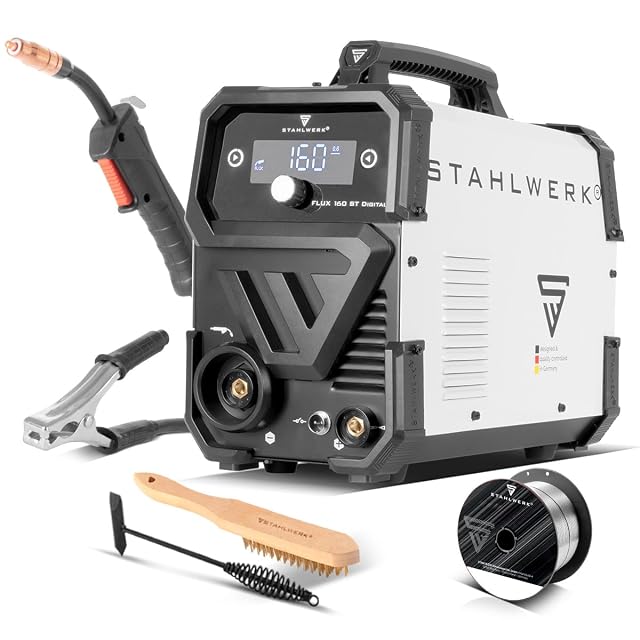
STAHLWERK FLUX 160 ST Digital

For work that: Gates, trailers, fence posts and anything welded where you cannot close a door
Where it is best: No gas bottle to rent, fill, store or carry — the running cost is wire alone

Where it is worst: Gasless only: you cannot fit a bottle later and weld clean MIG with it

Read the full review →

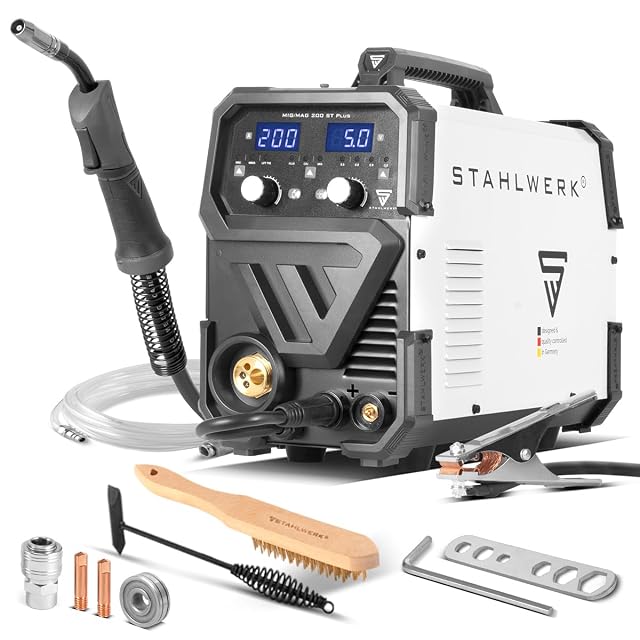
STAHLWERK MIG/MAG 200 ST

For work that: A first serious MIG that will still be adequate after two years of use

Where it is best: Synergic control: you set the material and thickness, the machine sets the wire speed

Where it is worst: The duty cycle is not stated with its temperature in the listing, so 200 A is a ceiling, not a working figure

Read the full review →

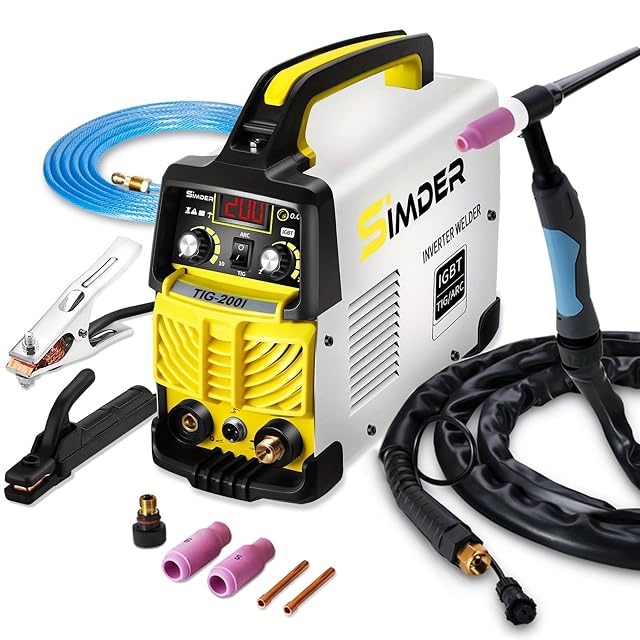
S SIMDER TIG200 (140 A DC)

For work that: Finding out whether you like TIG before spending €400 on one

Where it is best: Lift start emits no high-frequency interference — nothing in the house gets upset

Where it is worst: DC only: no aluminum, ever, whatever the listing photographs suggest

Read the full review →

What it will consume

Tips, nozzles, wire and gas from the same aisle, at the price we read. Confirm they suit the machine you choose before ordering: it turns on the torch and the part number, which the product page gives.

The call, in one line

Comparisons that are worth reading

Welder against welder, where the comparison is already written up.

What this selection rests on

The welders here are taken from the catalog of this site. Specifications come from the maker and from the Amazon product page; prices are what Keepa reported for the date shown, and both move. The order rests on declared specifications, on stated strengths against stated limits, and on price. No machine here has struck an arc in our hands, and nothing on this page pretends it has.

Last checked on

Prices quoted in these summaries are dated readings. The live price is shown next to each product.

The tool we use ourselves

Chosen your machine? Now buy it at the right price.

Welders and plasma cutters swing by a hundred dollars or more across the year, and the biggest "discounts" often land at prices the same model sold for six weeks earlier. UniverTrack tracks the real price history across retailers, spots fake reductions, and alerts you when it is genuinely the moment to buy.

Real price historyBuy-now alertsAI buying assistant
Try free for 14 days →
No commitment · Cancel in one click · 5 languages