Skip to content

Setting up a welding bench

Steel moves as it cools, and a weld pulls with far more force than any magnet can resist. A welding bench exists to hold the work square through that shrinkage, and every component on it is chosen with that single fact in mind.

Steel moves as it cools, and a weld pulls with far more force than any magnet can resist. A welding bench exists to hold the work square through that shrinkage, and every component on it is chosen with that single fact in mind.

Which welder suits your metal?

You weld small parts occasionally
A thick steel plate on a solid frame, some clamps and a good earth will hold everything you need.
You assemble frames that must come out square
A table with clamping holes: repeatable squareness is what changes the work, not the mass of the top.
You work on parts that pull a lot as they cool
You need rigid clamping and a planned welding sequence, not magnets.
You are short of space
A removable top on trestles beats a table too small, which you will end up covering in tools anyway.

Picking by the metal

Frame assembly

The most demanding case: four corners to hold while the metal shrinks. The table decides the outcome more than the machine does.

Repairing existing parts

Nothing is flat, nothing is square. What counts is the packing — shims, jacks, adjustable supports — not the flatness of the top.

Tacking before final welding

Tacks fix the geometry. A table that lets you tack without fighting the part saves everything downstream.

Working on installed work

When the part will not come to the table, the table becomes a mobile earth and a means of packing. That is a different trade.

What matters at the arc

Flatness, and what it is actually worth
A steel top moves when it gets hot. The useful flatness is the one you still have after a hundred hours of work, not the one on the datasheet.
Top thickness
It decides distortion under heat and how much inertia you have. A thin top moves and passes vibration on; a thick one costs, weighs, and never gets moved again.
Clamping
Standard clamping holes, or slots, or nothing at all. That is what separates a welding table from a bench you happen to weld on.
The earth connection
On a conductive, properly connected table, the earth is made once. It is a daily convenience, and one less cause of unstable arcs.

Which figure for which metal

What you needThe right toolWhat it will not do
Hold a corner while tackingA bolted-down clamping squareA magnet will not resist shrinkage
Pull two edges togetherA clamp or locking pliersA magnet positions, it does not clamp
Position quickly before clampingA welding magnetIt replaces no clamp at all
Carry the return currentA conductive table with a fixed earthAn earth on paint conducts nothing

Where it goes wrong at the bench

Treating a magnet as a clamp
A magnet positions, it does not clamp. Shrinkage on cooling generates forces no ordinary welding magnet will hold.
Welding on a wooden bench
Heat, spatter and return current: three reasons to keep the welding station separate from the assembly bench.
Earthing to the frame rather than the part
The current then travels through joints, bearings and whatever else is in the way. What gets damaged does not show up straight away.
Welding in the wrong order
A perfect table will not rescue a sequence that piles all the shrinkage on one side. Alternate, spread it out, let it cool.

By the welder you are

The occasional station
A steel top on trestles, a few clamps, a fixed earth. Cheap, and already well above an improvised bench.
The regular fabricator
A table with clamping holes and a set of squares: the time saved at assembly pays for itself in parts that come out right.
The shared workshop
A removable top, an earth that stays put, and storage where every clamp has its place.

Consumables, duty cycle and working life

A welding table degrades by accumulation: spatter, tack marks, a top that has bowed. It never breaks down; it gradually becomes less accurate — and you find out on the parts.

  • Use anti-spatter before high-spatter work: what does not stick does not have to be chipped off later.
  • Take spatter off with a scraper rather than a grinder, which digs into the top.
  • Check the squareness of the clamping accessories now and then: they are what provide the reference.
  • Keep the clamping holes clean; one fouled hole throws the whole part out of line.

Safety

A properly set-up welding station removes part of the risk before the arc is even struck.

  • A non-combustible floor under and around the table, over the radius spatter reaches.
  • Nothing flammable stored under the top — the place where everything ends up.
  • A suitable extinguisher within reach, and a period of watching after you stop.
  • A welding screen if anyone can walk behind you.

What we chose, and on what basis

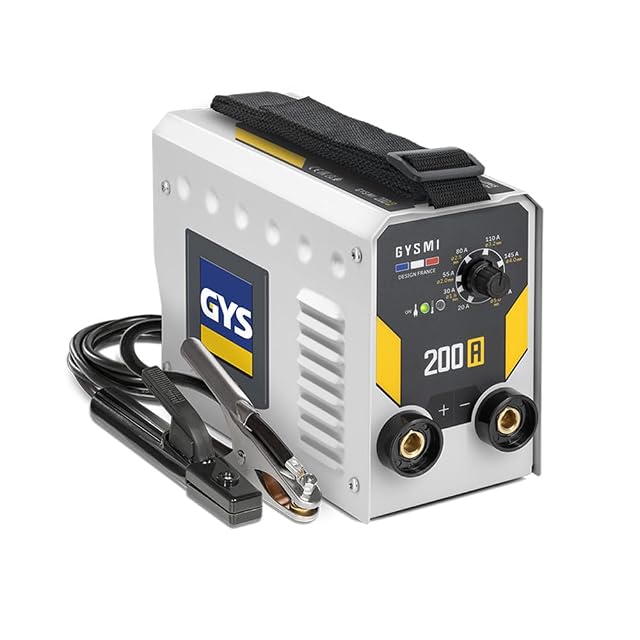
  1. GYS GYSMI 200 A

    200 A · 230 V · rutile, basic, stainless, cast iron to Ø 4 mm (0.16 in) · €263

    The only machine in this batch live on all six markets, and the only one that names the electrode types it is built for.

    Best for: Someone who welds cast iron or runs basic electrodes and wants the machine to cope

    8.1/10

    ≈ $405

The questions welders ask

Why are magnets not enough?

Because a cooling weld shrinks with more force than a 13 or 22 kg (48.5 lb) magnet can hold, and because magnets lose grip on hot steel. Their job is positioning: set the angle, tack both ends, remove the magnet, clamp mechanically, then weld. Skipping the middle steps is the commonest reason a frame is not square.

Where should the earth clamp go?

As close to the weld as practical, on clean bare metal. A long path through a table, a hinge or a bearing sends the current somewhere unintended — through bearings it causes pitting, and through a poor connection it makes the arc unstable in a way no machine setting will fix.

How thick should the top be?

Thick enough not to bow under the heat of everyday work, reasonable enough to stay movable if space demands it. The compromise depends on what you weld; a thin top is paid for in distortion.

Holed table or solid top?

A holed table changes how you clamp: squares and jacks go wherever you want, and squareness becomes repeatable. A solid top stays better for dirty work and for dressing with a grinder.

How do I stop the part distorting as I weld?

Clamp firmly, tack at spread-out points before running continuous beads, and alternate sides to balance the shrinkage. Welding sequence matters as much as clamping.

Can I weld on a galvanized table?

Best avoided: the heat vaporizes the zinc and produces fume that no makeshift ventilation handles properly. A bare steel top, even a rusty one, is preferable.

What lighting does a welding station need?

General light strong enough to prepare and inspect, and a raking light to reveal surface defects. During the bead only contrast under the helmet counts: a dark background helps more than harsh light.

Should the table be bolted down?

Only if it takes the loads of bending or straightening work. For welding alone, enough mass and adjustable feet beat an anchorage that stops you moving it.

Each welder, and the metal it is meant for

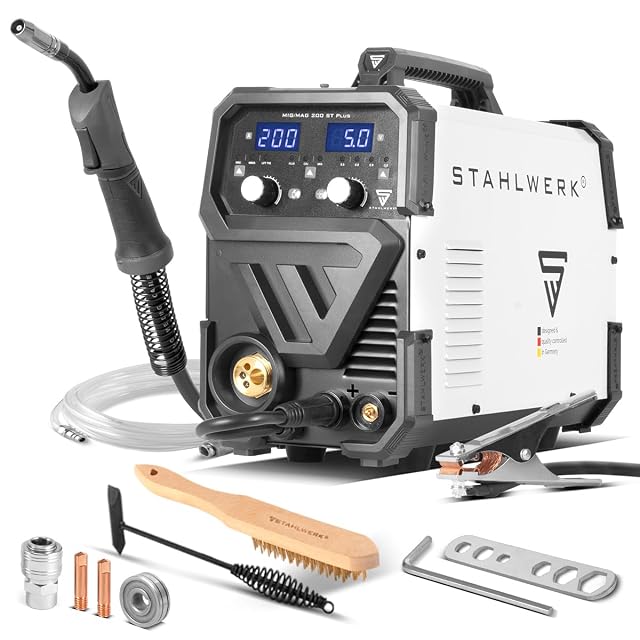
STAHLWERK MIG/MAG 200 ST

For work that: A first serious MIG that will still be adequate after two years of use
Where it is best: Synergic control: you set the material and thickness, the machine sets the wire speed

Where it is worst: The duty cycle is not stated with its temperature in the listing, so 200 A is a ceiling, not a working figure

Read the full review →

GYSMI 200 A · $405

For work that: Someone who welds cast iron or runs basic electrodes and wants the machine to cope

Where it is best: Names the electrode families it handles — including basic and cast iron, which cheaper machines avoid mentioning

Where it is worst: €263, against €90 to €140 for the machines above it

Read the full review →

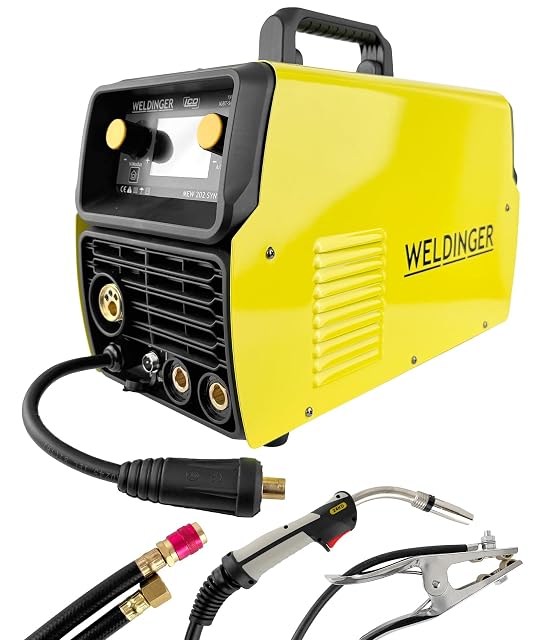
WELDINGER MEW 202 SYN puls dig

For work that: Aluminum work, and anyone who wants the weld to look like the ones in the photographs

Where it is best: Pulse and double pulse, with aluminum synergic programs — the reason to buy it

Where it is worst: €600 buys 200 A here and 200 A elsewhere for half that — you are paying for pulse

Read the full review →

What it will consume

Tips, nozzles, wire and gas from the same aisle, at the price we read. Confirm they suit the machine you choose before ordering: it turns on the torch and the part number, which the product page gives.

The call, in one line

  • If the work demands our rating → look at GYSMI 200 A

Comparisons that are worth reading

Welder against welder, where the comparison is already written up.

What this selection rests on

The welders here are taken from the catalog of this site. Specifications come from the maker and from the Amazon product page; prices are what Keepa reported for the date shown, and both move. The order rests on declared specifications, on stated strengths against stated limits, and on price. No machine here has struck an arc in our hands, and nothing on this page pretends it has.

Last checked on

Prices quoted in these summaries are dated readings. The live price is shown next to each product.

The tool we use ourselves

Chosen your machine? Now buy it at the right price.

Welders and plasma cutters swing by a hundred dollars or more across the year, and the biggest "discounts" often land at prices the same model sold for six weeks earlier. UniverTrack tracks the real price history across retailers, spots fake reductions, and alerts you when it is genuinely the moment to buy.

Real price historyBuy-now alertsAI buying assistant
Try free for 14 days →
No commitment · Cancel in one click · 5 languages