Skip to content

Welding aluminum: what you actually need

Aluminum is not steel with a different setting. Its oxide layer melts far hotter than the metal underneath, so TIG requires alternating current, and MIG requires wire that will feed without buckling. Everything else follows from those two facts.

Aluminum is not steel with a different setting. Its oxide layer melts far hotter than the metal underneath, so TIG requires alternating current, and MIG requires wire that will feed without buckling. Everything else follows from those two facts.

Which welder suits your metal?

You weld thicker aluminum in continuous runs
MIG with a spool gun: aluminum wire is too soft to push down a long liner.
You want a finished bead, or you are on thin sheet
AC TIG: it is the alternating current that breaks the oxide layer on every cycle.
You are repairing occasionally, without investing
A low-temperature aluminum brazing rod can be enough for a non-structural repair — it is not welding, and you should know that going in.
You weld aluminum once a year
Having it done often costs less than equipping the shop: machine, wire and gas only pay off with use.

Picking by the metal

Repairing castings

The hardest case: the alloy is unknown and often full of impurities. The area has to be cleaned mechanically and the filler chosen with care.

Joining extrusions

The favorable case: known alloy, even thickness, preparation possible. MIG with a spool gun is efficient here.

Thin sheet

Aluminum conducts heat far faster than steel and does not glow before it collapses. AC TIG gives the control you need.

Visible beads

AC TIG is the only process that gives a presentable aluminum bead with no rework.

What matters at the arc

Alternating current, in TIG
Aluminum carries an oxide layer that melts far above the metal underneath. Alternation strips that layer every half-cycle: without it, the pool never forms properly.
Wire feeding, in MIG
Aluminum wire buckles in an ordinary liner. Spool gun, or failing that a PTFE liner and U-groove rollers: it is the first cause of failure in aluminum MIG.
Cleanliness, no compromise
A stainless brush kept for aluminum alone, degreasing immediately before, and welding straight after. The oxide re-forms within minutes.
Heat input
Aluminum sheds heat so fast that heavy sections often need preheating — and leaves so little margin that thin sheet blows through with no transition.

Which figure for which metal

What you weldThe processWhat else you need
Extrusions, medium thicknessMIG with a spool gunWire matched to the alloy, argon
Thin sheet, visible beadAC TIGSuitable tungsten, argon, patience
Casting repairAC TIGMechanical cleaning, chosen filler
Non-structural repairLow-temperature brazingKnowing it is not welding

Where it goes wrong at the bench

Expecting a steel MIG to run aluminum with aluminum wire
Without a spool gun or a suitable liner, the wire buckles and birdnests at the rollers. It is the commonest disappointment.
Cleaning with steel-contaminated abrasives
A brush or disc that has touched steel embeds ferrous particles in the aluminum. Keep tooling for aluminum, and for nothing else.
Waiting for a color change
Aluminum does not glow. It looks the same right up to the moment it collapses. The cue is the pool, not the color.
Welding an unknown alloy
Some alloys are known to be difficult and crack on cooling. When the part is a casting of unknown origin, a test on a hidden area avoids the nasty surprise.

By the welder you are

The repairer
A spool gun on an existing MIG, if the machine accepts one: the cheapest route to usable aluminum.
The fabricator
An AC TIG, for bead quality and control on thin sheet — at the price of a genuine apprenticeship.
The occasional user
Aluminum brazing to get out of trouble, knowing what it is worth and what it is not, rather than kit that will sit idle.

Consumables, duty cycle and working life

Aluminum is demanding on consumables: wire oxidizes in store, tungsten contaminates at the first touch of the pool, and the liner fills with soft particles. Bead consistency follows the state of those three directly.

  • Keep aluminum wire in a sealed bag: oxidized, it gives porosity no setting will fix.
  • Regrind the tungsten as soon as it has touched the pool, and grind it lengthwise.
  • Blow out or replace the liner regularly: aluminum leaves a powder that drags on the wire.
  • Keep brushes and discs for aluminum only, stored separately and marked.

Safety

The same risks as for steel, with two particularities: radiation is more intense on alternating current, and fine aluminum dust is flammable.

  • Match the filter shade properly: AC TIG dazzles more than DC TIG at the same current.
  • Never vacuum aluminum dust with a vacuum that already holds steel dust.
  • Extract the fume: the alloys contain metals other than aluminum.
  • Make sure the part is properly degreased: heated solvents give off dangerous compounds.

What we chose, and on what basis

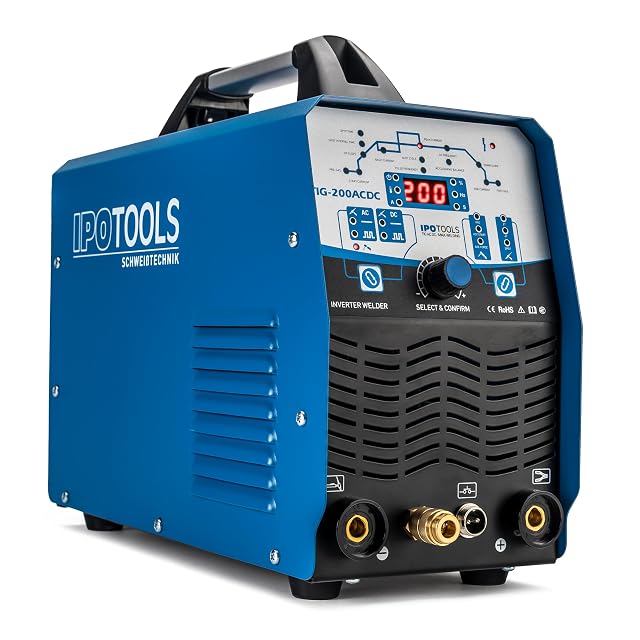
  1. IPOTOOLS TIG-200ACDC

    200 A AC/DC · AC frequency 20–100 Hz · spot 0.01–9.99 s · €459

    The first machine on this page that publishes its AC frequency range and pulse frequencies — the controls aluminum actually needs.

    Best for: Aluminum work where the arc has to be steered, not just switched on

    7.8/10

The questions welders ask

Can I weld aluminum with a DC TIG machine?

No. Direct current cannot break the oxide layer, and no gas, tungsten or technique substitutes for it. This is the single hardest limit in welding, and it is why AC/DC machines cost more. If aluminum is anywhere in your plans, buy AC now — it cannot be added later.

Why does aluminum MIG wire jam?

Because it is soft. Steel wire is stiff enough to push four meters down a liner; aluminum compresses and coils behind the drive rollers. The fixes, in order: a spool gun with the spool in the handle, a Teflon liner with U-groove rollers, or a very short torch.

Does aluminum need preheating?

On heavy sections, often yes, because the metal sheds heat faster than it arrives. Preheat stays moderate: too hot and aluminum loses its strength and collapses with no warning.

How do I identify the alloy of a part?

Without a marking, you cannot know for certain. Commercial extrusions are generally weldable alloys; castings are far less predictable. In doubt, a test on a hidden area is the only real check.

What gas for aluminum?

Argon in the great majority of cases. Helium mixes exist to raise heat input on heavy sections, with a different cost and a different set-up.

Why is my aluminum bead black and powdery?

That points to a lack of gas shielding or a poorly prepared surface. Check flow, nozzle and drafts, then the cleaning: the oxide re-forms within minutes.

Does aluminum brazing really hold?

On non-structural repairs and lightly loaded parts it is useful. It does not replace a weld on something that works, and presenting it otherwise would be misleading.

Do I need a TIG with balance control?

That is the setting that trades oxide cleaning against penetration. Without it you work with a fixed compromise: possible, but less fine on thin sheet and less clean on oxidized parts.

Each welder, and the metal it is meant for

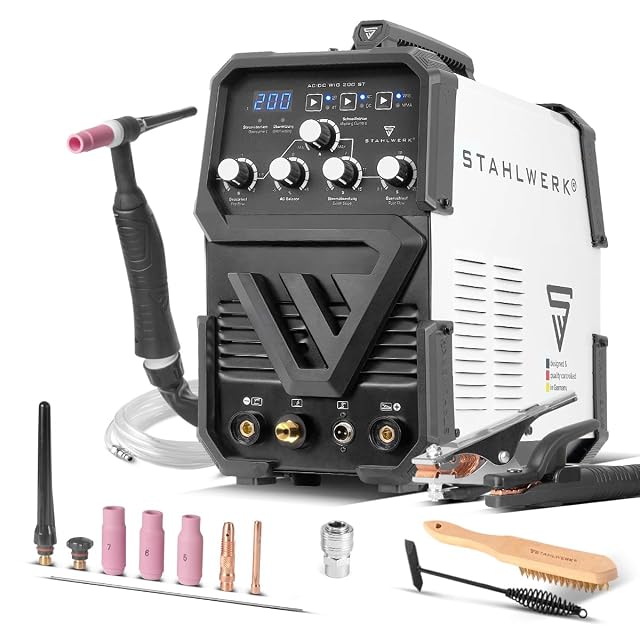
STAHLWERK AC/DC WIG 200 ST

For work that: A first AC/DC machine, bought because aluminum is somewhere in the plan
Where it is best: AC mode breaks the oxide layer, so aluminum is genuinely on the menu

Where it is worst: 12.7 kg (28 lb) — the heaviest machine in this price band here

Read the full review →

IPOTOOLS TIG-200ACDC

For work that: Aluminum work where the arc has to be steered, not just switched on

Where it is best: AC frequency adjustable from 20 to 100 Hz — this is what focuses the arc on aluminum

Where it is worst: €459 — the point at which a TIG machine stops being an impulse purchase

Read the full review →

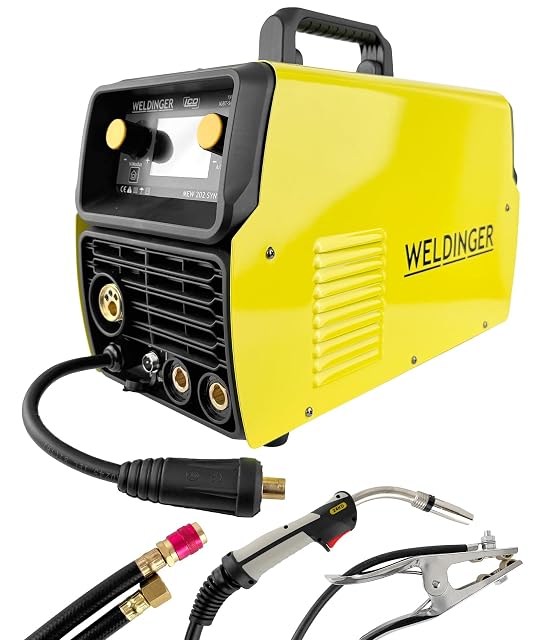
WELDINGER MEW 202 SYN puls dig

For work that: Aluminum work, and anyone who wants the weld to look like the ones in the photographs

Where it is best: Pulse and double pulse, with aluminum synergic programs — the reason to buy it

Where it is worst: €600 buys 200 A here and 200 A elsewhere for half that — you are paying for pulse

Read the full review →

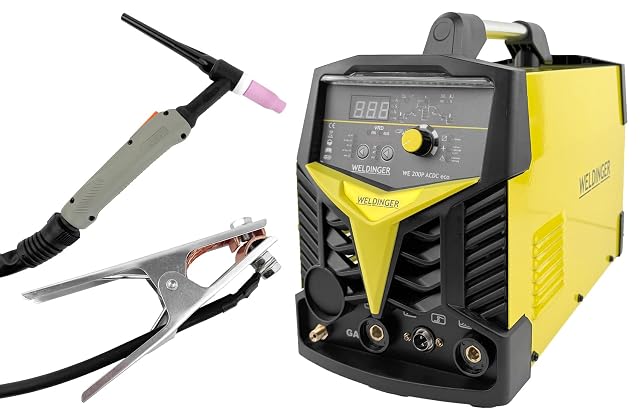
WELDINGER WE 200P ACDC eco

For work that: Thin stainless and aluminum, and anyone who has to carry the machine upstairs

Where it is best: A published lower limit of 10 A — the figure that decides what you can do on foil-thin stainless

Where it is worst: « High duty cycle » is claimed without a number, which is the one place the sheet goes vague

Read the full review →

What it will consume

Tips, nozzles, wire and gas from the same aisle, at the price we read. Confirm they suit the machine you choose before ordering: it turns on the torch and the part number, which the product page gives.

The call, in one line

Comparisons that are worth reading

Welder against welder, where the comparison is already written up.

What this selection rests on

The welders here are taken from the catalog of this site. Specifications come from the maker and from the Amazon product page; prices are what Keepa reported for the date shown, and both move. The order rests on declared specifications, on stated strengths against stated limits, and on price. No machine here has struck an arc in our hands, and nothing on this page pretends it has.

Last checked on

Prices quoted in these summaries are dated readings. The live price is shown next to each product.

The tool we use ourselves

Chosen your machine? Now buy it at the right price.

Welders and plasma cutters swing by a hundred dollars or more across the year, and the biggest "discounts" often land at prices the same model sold for six weeks earlier. UniverTrack tracks the real price history across retailers, spots fake reductions, and alerts you when it is genuinely the moment to buy.

Real price historyBuy-now alertsAI buying assistant
Try free for 14 days →
No commitment · Cancel in one click · 5 languages