Skip to content

Drilling steel: speed, pressure, fluid

Three things ruin drill bits in steel: too much speed, too little pressure and no cutting fluid. All three are free to fix, and none of them is about the machine — but the machine sets the limits, and the two figures to check are the lowest speed and the quill travel.

Three things ruin drill bits in steel: too much speed, too little pressure and no cutting fluid. All three are free to fix, and none of them is about the machine — but the machine sets the limits, and the two figures to check are the lowest speed and the quill travel.

Which welder suits your metal?

You drill small holes in flat bar
A bench pillar drill will do, provided it goes low enough in speed.
You drill beyond thirteen millimeters
You need torque at low speed: a belt-driven machine with a genuine slow range, or a Morse taper spindle.
You drill a part you cannot move
A magnetic drill and annular cutters, not a twist drill held at arm’s length.
You drill stainless or hardened steel
The question is no longer the machine but the bit and the cutting fluid: cobalt, steady pressure, low speed.

Picking by the metal

Assembly holes

Bolt holes in flat bar or section. Moderate speed, a little lubricant, and a depth stop so you don’t drill the bench as well.

Large diameters

Beyond sixteen millimeters, a pilot hole or an annular cutter beats a solid drill, which asks for torque few shop machines have.

Tapping

The pillar drill acts as a squareness guide, motor disengaged or at its lowest speed. It is being out of square that breaks taps, not the force applied.

Stainless and alloy steels

Low speed, firm continuous pressure. It is letting the chip stop that work-hardens the surface and makes the hole impossible to finish.

What matters at the arc

The LOWEST speed, not the highest
Useful spindle speed falls as diameter rises. A machine whose minimum speed stays high will never drill large holes properly, whatever its quoted power.
Spindle travel
It decides what thickness you can drill in one pass. Short travel forces a re-grip mid-hole, and the re-grip shows.
Spindle runout
Play reads straight off the hole: oval entry, a bit that chatters. It is what separates machines most clearly, and it does not improve with age.
The table and how you clamp to it
A table with no slots forces you to hold the work by hand — the commonest cause of pillar-drill injuries.

Which figure for which metal

What you drillSpeedWhat you need
Mild steel, small diameterFastOrdinary HSS bit, light lubricant
Mild steel, large diameterSlowPilot hole or annular cutter, serious clamping
StainlessSlowCobalt bit, steady pressure, cutting oil
Hardened steelVery slowCoated or carbide bit, a rigid machine

Where it goes wrong at the bench

Drilling too fast
The commonest and costliest mistake: at excessive speed the cutting edge heats, loses its hardness, and the bit is gone in seconds.
Treating cutting oil as a coolant
Cutting fluid works first on friction at the edge. That is why you apply it before and during, not to douse the hole afterwards.
Easing off the pressure
On stainless especially, a bit turning without cutting work-hardens the surface: the bottom of the hole ends up harder than when you started.
Holding the work by hand
A bit that grabs turns an offcut of sheet into a spinning blade. Clamping is not a comfort measure.

By the welder you are

The home workshop
A belt-driven bench pillar drill whose low range goes down far enough for mid-size diameters covers most of the work.
The fabricator
Spindle travel and rigidity matter more than quoted power: they are what decide hole quality.
The site engineer
Magnetic drill and annular cutters: the only way to drill cleanly into a part you cannot bring to the machine.

Consumables, duty cycle and working life

A pillar drill wears little and drifts out of adjustment a lot. Most bad holes come from a setting or a grind, not from a tired component.

  • Clean the spindle taper and the chuck: one chip lodged in there is enough to create runout.
  • Regrind or replace a bit as soon as the chip stops coming off as two even ribbons.
  • Check the table is square to the spindle after any knock.
  • Grease the rack and column so the scoring that eventually jams the adjustment never starts.

Safety

The main danger is not the bit: it is the workpiece starting to turn with it.

  • Clamp every time, including for a four-millimeter hole in an offcut.
  • No gloves and no loose sleeves near a turning spindle.
  • Remove the chuck key before switching on, and make forgetting it impossible with a spring-loaded key.
  • Never clear swarf by hand: it cuts, and it is hot.

What we chose, and on what basis

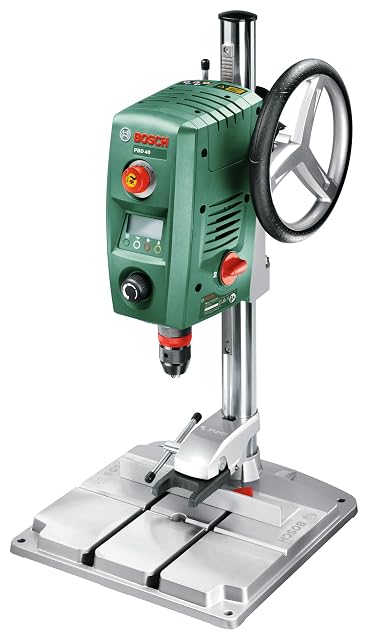
  1. Bosch PBD 40

    710 W · 13 mm (0.51 in) in steel · 90 mm (3.54 in) quill travel · €250

    Ninety millimeters of quill travel — nearly twice the entry machines, and the figure that decides deep holes.

    Best for: Deep holes in solid stock, and anyone tired of repositioning halfway down
    8.1/10

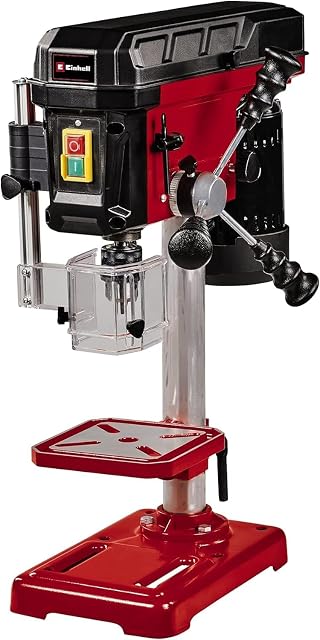
  2. Einhell TC-BD 450

    450 W · 600–2,650 rpm in 5 steps · 50 mm (1.97 in) depth · €115

    A published speed range starting at 600 rpm — low enough for large bits in steel, which many small presses are not.

    Best for: Drilling steel with bits over 8 mm (0.31 in), where speed matters more than power

    6.9/10

The questions welders ask

What speed for a 13 mm (0.51 in) bit in steel?

Roughly 500 to 700 rpm for mild steel, and lower for stainless. The principle is that cutting speed at the rim rises with diameter, so a bigger bit must turn slower to keep the edge below the temperature at which it loses hardness. A press whose slowest setting is 1,000 rpm cannot drill large holes in steel without destroying bits.

Why does quill travel matter?

Because it sets how deep a hole you can drill without repositioning the work — and repositioning is exactly what a drill press exists to avoid. Fifty millimeters covers plate and box section; 90 mm (3.54 in) covers most solid bar. It is the specification most listings omit.

Should I always pilot-drill?

Beyond a certain diameter, yes: the web of the drill does not cut, it crushes. A pilot hole at web diameter cuts the effort sharply and improves centering. Below that it wastes time and adds nothing.

HSS, cobalt or carbide — which bit?

HSS is enough for mild steel. Cobalt starts to earn its place on stainless and alloy steels, where heat is the problem. Carbide is for hard materials and needs a rigid machine: on a flexible pillar drill it chips.

Can I drill with a hand drill?

For small diameters and assembly work, yes. Beyond that the difficulty is not power but squareness and torque reaction: that is where a pillar drill or a magnetic drill becomes necessary.

Why does my bit squeal and stop advancing?

Almost always because it is turning too fast and no longer biting: the edge has overheated, rounded off and is now rubbing. Pressing on achieves nothing; regrind or replace, and come down in speed.

What can I use if I have no cutting oil?

Cutting oil is better, but ordinary mineral oil beats nothing at all on steel. Avoid water on its own, which does not lubricate, and use nothing on cast iron, which is drilled dry.

How do I drill sheet without distorting it?

By supporting it across its whole area — a piece of scrap wood underneath — and easing the pressure as the bit breaks through. It is at breakthrough that sheet lifts and tears, not on the way down.

Each welder, and the metal it is meant for

Bosch PBD 40

For work that: Deep holes in solid stock, and anyone tired of repositioning halfway down
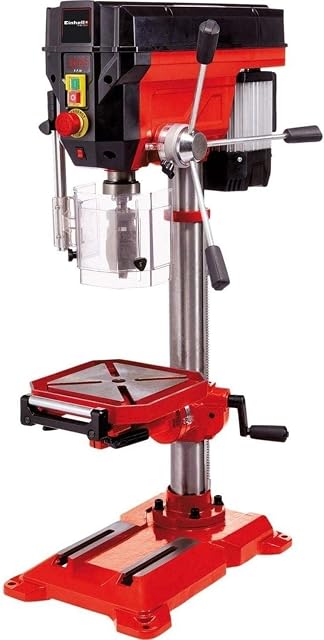
Where it is best: 90 mm (3.54 in) of travel, against 50 mm (1.97 in) on the entry machines

Where it is worst: €250 for 710 W — you are buying travel and electronics

Read the full review →

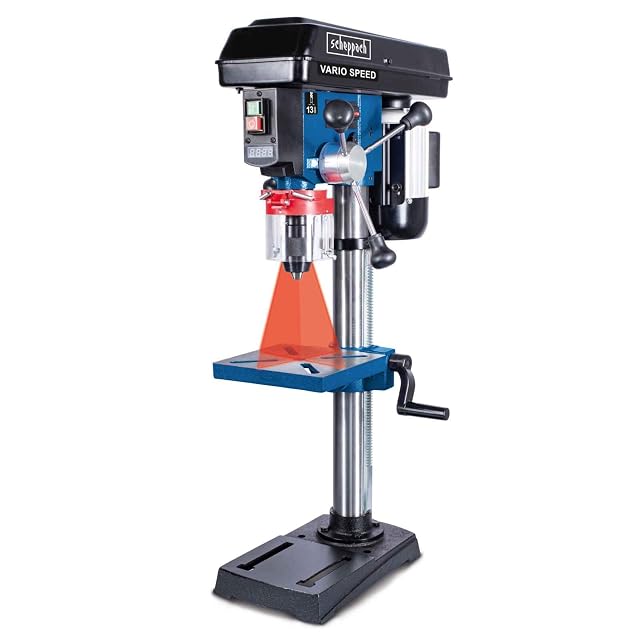
Scheppach DP19Vario

For work that: Mixed-material work where the speed changes several times an hour

Where it is best: Stepless speed control — no belt changes, and any speed in the range

Where it is worst: €228, more than twice the entry machines

Read the full review →

Einhell TE-BD 750 E · $975

For work that: A workshop where the drill press runs daily and angled work is routine

Where it is best: An induction motor: quiet, brushless, and it holds speed under load

Where it is worst: €370 — the most expensive of the European drill presses here

Read the full review →

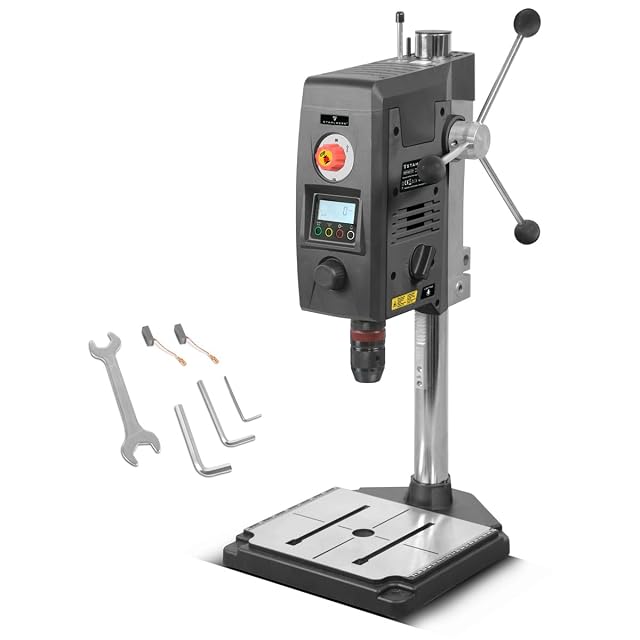
STAHLWERK Bench drill 800 W

For work that: Repetitive hole positions where alignment by eye costs time

Where it is best: 800 W, the most powerful bench press in this batch

Where it is worst: A laser is an aid, not a substitute for a center punch

Read the full review →

Einhell TC-BD 450

For work that: Drilling steel with bits over 8 mm (0.31 in), where speed matters more than power

Where it is best: 600 rpm bottom speed, which is what large bits in steel need

Where it is worst: 450 W is the least powerful press here

Read the full review →

What each price step puts in your hands

What it will consume

Tips, nozzles, wire and gas from the same aisle, at the price we read. Confirm they suit the machine you choose before ordering: it turns on the torch and the part number, which the product page gives.

The call, in one line

What this selection rests on

The welders here are taken from the catalog of this site. Specifications come from the maker and from the Amazon product page; prices are what Keepa reported for the date shown, and both move. The order rests on declared specifications, on stated strengths against stated limits, and on price. No machine here has struck an arc in our hands, and nothing on this page pretends it has.

Last checked on

Prices quoted in these summaries are dated readings. The live price is shown next to each product.

The tool we use ourselves

Chosen your machine? Now buy it at the right price.

Welders and plasma cutters swing by a hundred dollars or more across the year, and the biggest "discounts" often land at prices the same model sold for six weeks earlier. UniverTrack tracks the real price history across retailers, spots fake reductions, and alerts you when it is genuinely the moment to buy.

Real price historyBuy-now alertsAI buying assistant
Try free for 14 days →
No commitment · Cancel in one click · 5 languages