Skip to content

Cutting steel to length: which machine

Four tools cut steel to length, and they differ in every dimension except the result. Speed, noise, edge quality and the cost of consumables all pull in different directions, and the right answer depends on what happens to the cut end afterwards.

Four tools cut steel to length, and they differ in every dimension except the result. Speed, noise, edge quality and the cost of consumables all pull in different directions, and the right answer depends on what happens to the cut end afterwards.

Which welder suits your metal?

You cut tube and flat bar, a few pieces at a time
An abrasive chop saw: quick to set up, loud, and the cut needs deburring.
You cut runs of parts that have to be square
A metal bandsaw: slow through the cut, but the squareness repeats and the offcut stays clean.
You cut solid bar regularly
A cold saw: the blade costs a lot to buy and little to use, and the finish often needs no second operation.
You cut in place, in an impossible position
An angle grinder: the only one that goes everywhere, at the cost of precision.

Picking by the metal

Cutting frame stock

Squareness decides everything: one degree of error repeated over four cuts turns into slop at assembly. Bandsaw and cold saw hold the angle; the grinder does not.

Mitres

This is where the quoted capacity misleads: makers publish capacity at ninety degrees, and it drops noticeably at forty-five.

Cutting sheet

None of these machines is meant for panel work: that belongs to shears, a nibbler or plasma. A chop saw on sheet distorts more than it cuts.

Strip-out on site

On metal that is already installed, an angle grinder with a thin cutting disc is the only workable option.

What matters at the arc

Capacity at 90° AND at 45°
The first is always quoted, the second rarely. If you cut mitres, the second figure is the one that describes what the machine can do.
Cutting speed, and whether it varies
Mild steel and stainless do not cut at the same speed. A single-speed machine will do one properly and wear its blade on the other.
The vice
A vice that lets the work twist under load ruins the cut and the blade. It is the most commonly under-specified part on entry-level machines, and the hardest to improve afterwards.
Cost per cut
An abrasive disc is cheap and short-lived; a bandsaw blade is expensive and lasts. The sum depends on cuts per year, not on the machine’s ticket price.

Which figure for which metal

MachineWhat it does wellWhat it costs in use
Abrasive chop sawFast cuts in tube and sectionDiscs consumed, noise, a shower of sparks
Metal bandsawRepeatable squareness, clean cutBlades to replace, slow cutting
Cold sawA finish that often needs nothing furtherExpensive blade, but a long-lived one
Angle grinderAccess anywhere, cutting in placeLow precision, many discs

Where it goes wrong at the bench

Cutting stainless with a mild-steel disc
Discs for carbon steel carry ferrous compounds that contaminate stainless and start pitting corrosion. You need a disc marked iron-free, kept for that job alone.
Trusting an expired disc
Abrasive discs carry an expiry date: past it, the bond has aged and the disc can burst. It is printed on the disc, and rarely read.
Clamping on one side only
A long unsupported offcut pinches the blade at the end of the cut. Clamp both sides of the line as soon as the piece can tip.
Taking the guard off
The guard is not in the way: it is what stands between you and a disc that comes apart, and it is sized for exactly that.

By the welder you are

The repair shop
A chop saw and a grinder cover almost everything, for a modest outlay and cheap consumables.
The occasional fabricator
The moment a frame has to be square, a bandsaw changes the nature of the work: the time spent correcting cuts disappears.
Working on site
Angle grinder, thin discs and spares, rather than a stationary machine you would have to power and level.

Consumables, duty cycle and working life

Cut quality always degrades before the machine does. A cut that wanders, blues or turns noisy points to a worn blade, a loose vice or a guide out of adjustment — rarely a fault. No blade life can be quoted: it depends on the metal, the speed and the clamping.

  • Clear swarf from the bed and the vice after every session: it stops the work sitting flat.
  • Check blade tension and tracking before concluding the blade is worn.
  • Store abrasive discs flat and dry: damp puts them out of balance.
  • Check the fence square with a square, not against the printed scale.

Safety

Cutting metal throws incandescent particles several meters and produces noise that reaches harmful levels over short periods.

  • Safety glasses UNDER the face shield, not instead of it.
  • Hearing protection: abrasive cutting is among the loudest shop operations.
  • Clear combustibles from the spark path, including behind lightweight partitions.
  • Let the machine stop on its own: slowing a disc by hand or against the work is the commonest way to break one.

What we chose, and on what basis

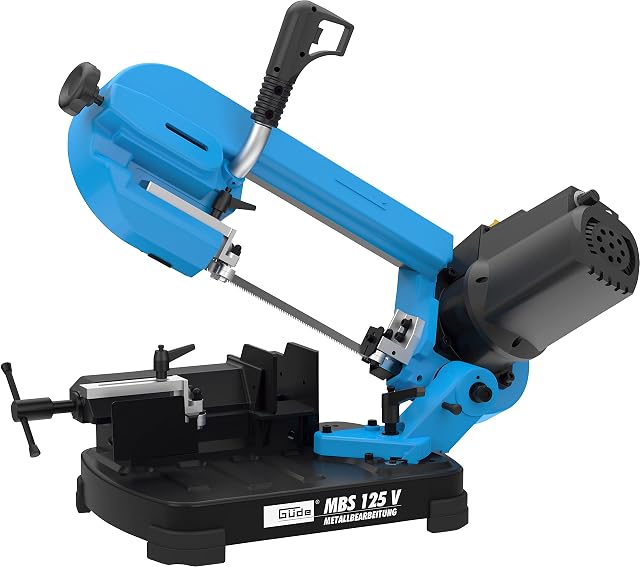
  1. Güde MBS 125 V

    400 W · 38–80 m (125 to 262 ft)/min variable · 0–60° mitre · €329

    Variable band speed and ball-bearing guides — the two things that decide whether a band saw cuts straight.

    Best for: A workshop cutting both steel and aluminum, where one speed would be wrong for one of them

    8.1/10

    ≈ $845

The questions welders ask

Abrasive or cold cut?

Abrasive is cheap, fast, loud and leaves a hot, blued, burred edge. Cold cut uses a carbide blade turning slowly, cuts cool and square, and costs four to seven times as much. If every cut is followed by a minute of dressing with a flap disc, count that minute across a year before deciding.

Where does a band saw fit?

Between the two: slower than either chop saw, quieter than both, with almost no material wasted and an edge that needs no dressing. It is the machine for a workshop where noise matters and the work is not urgent — and the only one of the three you can leave cutting while you do something else.

Can the same machines cut stainless?

Yes, provided you change consumable and speed. Discs and blades meant for carbon steel contaminate stainless; you need consumables marked iron-free, kept for that job, and a slower speed so the cut does not work-harden.

Should a bandsaw cut be lubricated?

On metal, yes: lubrication carries the heat away and extends blade life, and some machines have flood coolant built in. Dry cutting stays possible on small sections, at the cost of a blade that tires faster.

Why does my cut wander?

Three causes cover almost every case: a blade or disc at the end of its life, a vice that lets the work twist, or a guide out of adjustment. Check in that order before blaming the machine.

Will a wood mitre saw do with a metal blade?

No. The rotation speed, the direction of the forces and the absence of a guard built for sparks make it a dangerous set-up, even with a blade sold for metal. These machines do not share the same regimes.

How many cuts does a cutting disc last?

No honest figure can be given: it depends on the section, the metal, the pressure and the machine. What you watch is the remaining diameter and how cleanly it still cuts, not a counter.

Should I always deburr?

Yes, as soon as the part will be handled, painted or welded. A burr cuts, prevents a proper fit, and traps moisture under paint. It is two seconds with a file, and it saves reworking later.

Each welder, and the metal it is meant for

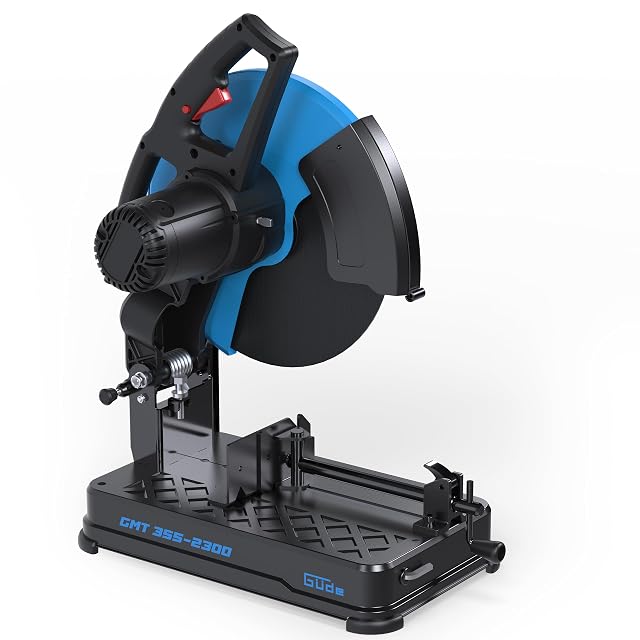
Güde GMT 355-2300

For work that: Cutting stock to length in a workshop where the noise is nobody else’s problem
Where it is best: €120 for a machine that cuts 50 mm (1.97 in) box section in one pull

Where it is worst: Abrasive cutting: sparks, noise and a burr on every cut

Read the full review →

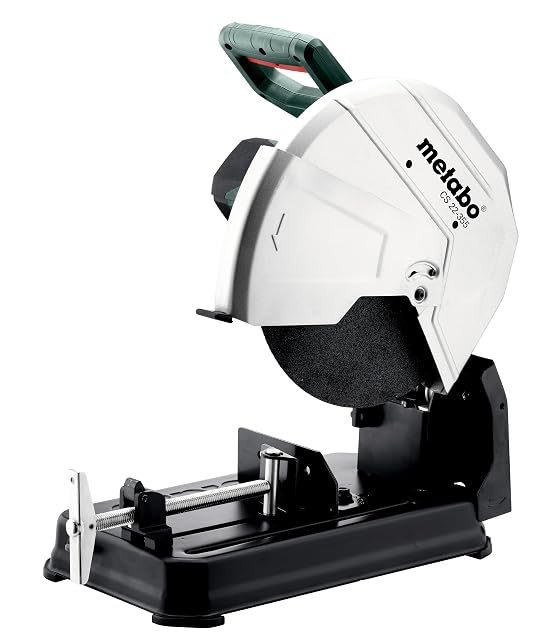
metabo CS 22-355

For work that: Repeated cuts on tube and box section, where a slipping vice ruins the angle

Where it is best: The vice adjusts continuously rather than in steps, so odd sections still clamp tight

Where it is worst: €60 more than the Güde for a similar cutting principle

Read the full review →

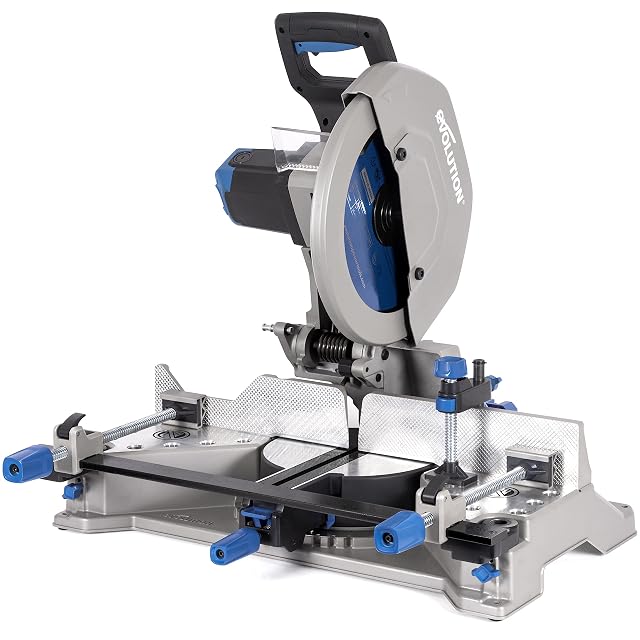
Evolution Power Tools S355MCS

For work that: Daily fabrication where every cut would otherwise be dressed by hand

Where it is best: Cold cutting: the offcut is cool enough to hold and the edge needs no dressing

Where it is worst: €880, seven times the abrasive machines above it

Read the full review →

Güde MBS 125 V · $845

For work that: A workshop cutting both steel and aluminum, where one speed would be wrong for one of them

Where it is best: Variable band speed: steel wants slow, aluminum wants fast, and one setting cannot do both

Where it is worst: 400 W is modest — this is a saw that takes its time

Read the full review →

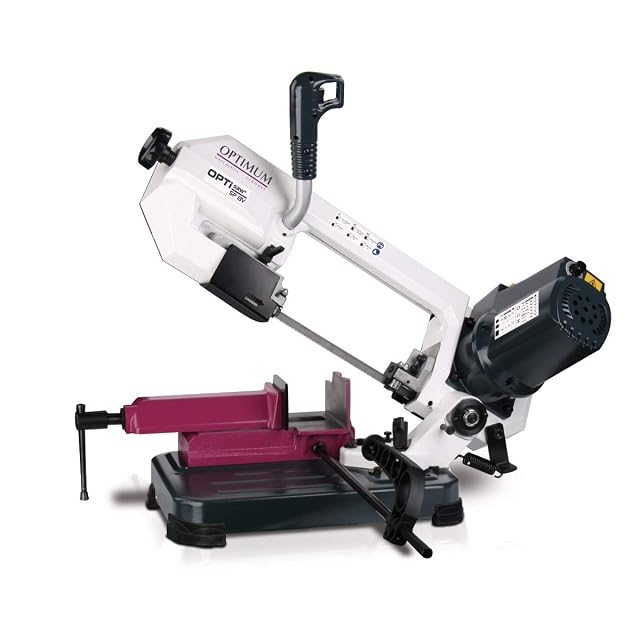
OPTIMUM OPTIsaw SP13V

For work that: Accurate mitres in solid bar, in a workshop that cannot house a full-size saw

Where it is best: Stepless speed adjustment, not two or three fixed steps

Where it is worst: €620, and it remains a small-capacity machine

Read the full review →

What it will consume

Tips, nozzles, wire and gas from the same aisle, at the price we read. Confirm they suit the machine you choose before ordering: it turns on the torch and the part number, which the product page gives.

The call, in one line

Comparisons that are worth reading

Welder against welder, where the comparison is already written up.

What this selection rests on

The welders here are taken from the catalog of this site. Specifications come from the maker and from the Amazon product page; prices are what Keepa reported for the date shown, and both move. The order rests on declared specifications, on stated strengths against stated limits, and on price. No machine here has struck an arc in our hands, and nothing on this page pretends it has.

Last checked on

Prices quoted in these summaries are dated readings. The live price is shown next to each product.

The tool we use ourselves

Chosen your machine? Now buy it at the right price.

Welders and plasma cutters swing by a hundred dollars or more across the year, and the biggest "discounts" often land at prices the same model sold for six weeks earlier. UniverTrack tracks the real price history across retailers, spots fake reductions, and alerts you when it is genuinely the moment to buy.

Real price historyBuy-now alertsAI buying assistant
Try free for 14 days →
No commitment · Cancel in one click · 5 languages